Ch. 2 - Limits
Briggs - Calculus: Early Transcendentals 3rd Edition
Briggs3rd EditionCalculus: Early TranscendentalsISBN: 9780136847243Non è quello che usi tu?Cambia libro di testo
Capitolo 2, Problema 80a

Analyze lim x→∞ f(x) and lim x→−∞ f(x), and then identify any horizontal asymptotes.


f(x)=3e^x+10 / e^x

Guida verificata passo dopo passo
1
Step 1: Identify the function f(x) = \(\frac{3e^x + 10}{e^x}\).
Step 2: Simplify the function by dividing each term in the numerator by e^x, resulting in f(x) = \(\frac{3e^x}{e^x}\) + \(\frac{10}{e^x}\).
Step 3: Simplify further to get f(x) = 3 + \(\frac{10}{e^x}\).
Step 4: Analyze \(\lim\)_{x \(\to\) \(\infty\)} f(x). As x approaches infinity, \(\frac{10}{e^x}\) approaches 0 because e^x grows exponentially. Therefore, \(\lim\)_{x \(\to\) \(\infty\)} f(x) = 3.
Step 5: Analyze \(\lim\)_{x \(\to\) -\(\infty\)} f(x). As x approaches negative infinity, e^x approaches 0, making \(\frac{10}{e^x}\) approach infinity. Therefore, \(\lim\)_{x \(\to\) -\(\infty\)} f(x) = \(\infty\).

Risposta video verificata per un problema simile:

Questa soluzione video è stata consigliata dai nostri tutor come utile per risolvere questo problema.
Durata del video:
3m

Concetti chiave

Ecco i concetti essenziali che devi comprendere per rispondere correttamente alla domanda.

Limits at Infinity

Limits at infinity involve evaluating the behavior of a function as the input approaches positive or negative infinity. This analysis helps determine the end behavior of the function, which is crucial for identifying horizontal asymptotes. For example, if the limit of f(x) as x approaches infinity is a finite number, it indicates that the function approaches a horizontal line at that value.
Video consigliato:
05:50
One-Sided Limits

Horizontal Asymptotes

Horizontal asymptotes are lines that a graph approaches as x approaches infinity or negative infinity. They represent the value that the function stabilizes at, indicating the long-term behavior of the function. A function can have one or two horizontal asymptotes, depending on its limits at both ends of the x-axis.
Video consigliato:
5:46
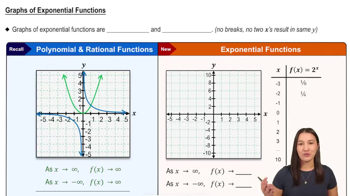
Graphs of Exponential Functions

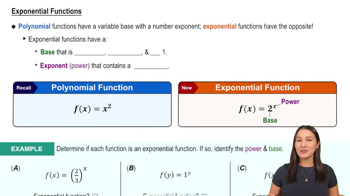
Exponential Functions

Exponential functions, such as f(x) = 3e^x + 10 / e^x, exhibit rapid growth or decay based on the base of the exponent. In this case, as x approaches infinity, the term involving e^x dominates, influencing the limit and the identification of horizontal asymptotes. Understanding the properties of exponential functions is essential for analyzing their limits and asymptotic behavior.
Video consigliato:
6:13
Exponential Functions