Ch. 2 - Limits
Briggs - Calculus: Early Transcendentals 3rd Edition
Briggs3rd EditionCalculus: Early TranscendentalsISBN: 9780136847243Non è quello che usi tu?Cambia libro di testo
Capitolo 2, Problema 2.75a

Analyze lim x→∞ f(x) and lim x→−∞ f(x), and then identify any horizontal asymptotes.
f(x) = (x2 − 9)/(x(x−3))

Guida verificata passo dopo passo
1
Start by simplifying the function \( f(x) = \frac{x^2 - 9}{x(x-3)} \). Notice that the numerator \( x^2 - 9 \) can be factored as \((x-3)(x+3)\). So, the function becomes \( f(x) = \frac{(x-3)(x+3)}{x(x-3)} \).
Cancel the common factor \( (x-3) \) from the numerator and the denominator, but remember that \( x \neq 3 \) to avoid division by zero. The simplified function is \( f(x) = \frac{x+3}{x} \).
To find the limit as \( x \to \infty \), consider \( f(x) = \frac{x+3}{x} = 1 + \frac{3}{x} \). As \( x \to \infty \), \( \frac{3}{x} \to 0 \), so \( \lim_{x \to \infty} f(x) = 1 \).
Similarly, for \( x \to -\infty \), \( f(x) = 1 + \frac{3}{x} \). As \( x \to -\infty \), \( \frac{3}{x} \to 0 \), so \( \lim_{x \to -\infty} f(x) = 1 \).
Since both \( \lim_{x \to \infty} f(x) \) and \( \lim_{x \to -\infty} f(x) \) equal 1, the horizontal asymptote of the function is \( y = 1 \).

Risposta video verificata per un problema simile:

Questa soluzione video è stata consigliata dai nostri tutor come utile per risolvere questo problema.
Durata del video:
6m

Concetti chiave

Ecco i concetti essenziali che devi comprendere per rispondere correttamente alla domanda.

Limits at Infinity

Limits at infinity involve evaluating the behavior of a function as the input approaches positive or negative infinity. This analysis helps determine the end behavior of the function, which is crucial for identifying horizontal asymptotes. For rational functions, this often involves comparing the degrees of the numerator and denominator.
Video consigliato:
05:50
One-Sided Limits

Horizontal Asymptotes

Horizontal asymptotes are lines that a graph approaches as the input values become very large or very small. They indicate the value that the function approaches at infinity. For rational functions, horizontal asymptotes can be found by analyzing the leading coefficients and degrees of the numerator and denominator.
Video consigliato:
5:46
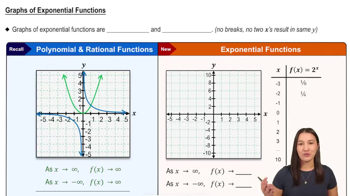
Graphs of Exponential Functions

Rational Functions

Rational functions are expressions formed by the ratio of two polynomials. The behavior of these functions, especially at infinity, is influenced by the degrees of the polynomials involved. Understanding how to simplify and analyze these functions is essential for determining limits and asymptotic behavior.
Video consigliato:
6:04
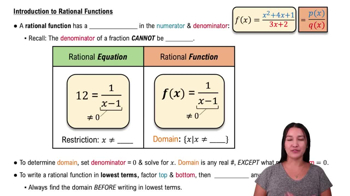
Intro to Rational Functions