Ch. 2 - Limits
Briggs - Calculus: Early Transcendentals 3rd Edition
Briggs3rd EditionCalculus: Early TranscendentalsISBN: 9780136847243Non è quello che usi tu?Cambia libro di testo
Capitolo 2, Problema 2.21a

For the following position functions, make a table of average velocities similar to those in Exercises 19–20 and make a conjecture about the instantaneous velocity at the indicated time. 


a. s(t)=−16t^2+80t+60 at t=3

Guida verificata passo dopo passo
1
Step 1: Understand the problem. We are given a position function s(t) = -16t^2 + 80t + 60, and we need to find the average velocities over intervals approaching t = 3.
Step 2: Calculate the average velocity over an interval [3, 3+h]. The average velocity is given by the formula: \( v_{avg} = \frac{s(3+h) - s(3)}{h} \).
Step 3: Substitute s(t) into the average velocity formula. Calculate s(3) and s(3+h) using the position function.
Step 4: Simplify the expression for average velocity. This involves expanding s(3+h) and simplifying the difference quotient.
Step 5: Make a conjecture about the instantaneous velocity at t = 3 by observing the behavior of the average velocity as h approaches 0.

Risposta video verificata per un problema simile:

Questa soluzione video è stata consigliata dai nostri tutor come utile per risolvere questo problema.
Durata del video:
12m

Concetti chiave

Ecco i concetti essenziali che devi comprendere per rispondere correttamente alla domanda.

Average Velocity

Average velocity is defined as the change in position over the change in time. Mathematically, it is calculated using the formula (s(t2) - s(t1)) / (t2 - t1), where s(t) represents the position function. This concept is crucial for understanding how position changes over intervals and is foundational for analyzing motion.
Video consigliato:
Percorso guidato
06:29
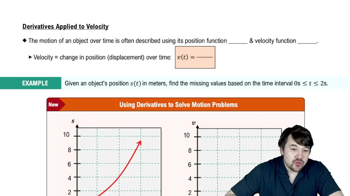
Derivatives Applied To Velocity

Instantaneous Velocity

Instantaneous velocity refers to the velocity of an object at a specific moment in time. It is determined by taking the limit of the average velocity as the time interval approaches zero. This concept is essential for understanding how an object's speed and direction change at any given point, and it is often represented as the derivative of the position function.
Video consigliato:
Percorso guidato
06:29
Derivatives Applied To Velocity

Position Function

A position function describes the location of an object as a function of time, typically denoted as s(t). In this case, s(t) = -16t^2 + 80t + 60 represents a quadratic function that models the motion of an object under the influence of gravity. Understanding the position function is vital for calculating both average and instantaneous velocities.
Video consigliato:
Percorso guidato
5:20
Relations and Functions