
Ch. 2 - Limits
Briggs - Calculus: Early Transcendentals 3rd Edition
Briggs3rd EditionCalculus: Early TranscendentalsISBN: 9780136847243Non è quello che usi tu?Cambia libro di testo
Capitolo 2, Problema 2.1.17

Consider the position function s(t)=−16t^2+128t (Exercise 13). Complete the following table with the appropriate average velocities. Then make a conjecture about the value of the instantaneous velocity at t=1. <IMAGE>

Guida verificata passo dopo passo
1
Step 1: Understand the problem. The position function s(t) = -16t^2 + 128t represents the position of an object at time t. We need to find average velocities over certain intervals and make a conjecture about the instantaneous velocity at t = 1.
Step 2: Recall the formula for average velocity over an interval [a, b], which is given by (s(b) - s(a)) / (b - a).
Step 3: Calculate the average velocity over the interval [1, 1+h] for small values of h. This involves computing (s(1+h) - s(1)) / h.
Step 4: Substitute s(t) = -16t^2 + 128t into the average velocity formula: (s(1+h) - s(1)) / h = ((-16(1+h)^2 + 128(1+h)) - (-16(1)^2 + 128(1))) / h.
Step 5: Simplify the expression from Step 4 and evaluate the limit as h approaches 0 to conjecture the instantaneous velocity at t = 1.

Risposta video verificata per un problema simile:

Questa soluzione video è stata consigliata dai nostri tutor come utile per risolvere questo problema.
Durata del video:
12m

Concetti chiave

Ecco i concetti essenziali che devi comprendere per rispondere correttamente alla domanda.

Position Function

A position function describes the location of an object at a given time, typically represented as s(t). In this case, s(t) = -16t^2 + 128t models the vertical position of an object under the influence of gravity, where t is time in seconds. Understanding this function is crucial for analyzing motion and calculating velocities.
Video consigliato:
Percorso guidato
5:20
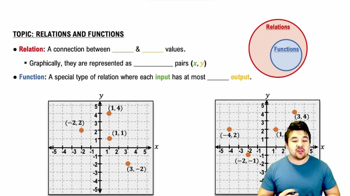
Relations and Functions

Average Velocity

Average velocity is defined as the change in position over the change in time, calculated as (s(t2) - s(t1)) / (t2 - t1). It provides a measure of how fast an object is moving over a specific interval. In the context of the given position function, calculating average velocities at different intervals helps in understanding the object's overall motion.
Video consigliato:
Percorso guidato
06:29
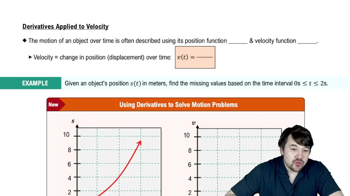
Derivatives Applied To Velocity

Instantaneous Velocity

Instantaneous velocity is the velocity of an object at a specific moment in time, represented mathematically as the derivative of the position function, v(t) = s'(t). It provides a precise measure of how fast the object is moving at that exact time. Making a conjecture about the instantaneous velocity at t=1 involves evaluating the derivative of the position function at that point.
Video consigliato:
Percorso guidato
06:29
Derivatives Applied To Velocity
Pratica correlata
Domanda del libro di testo

A sequence is an infinite, ordered list of numbers that is often defined by a function. For example, the sequence {2,4,6,8,…} is specified by the function f(n) = 2n, where n=1,2,3,….The limit of such a sequence is lim n→∞ f(n), provided the limit exists. All the limit laws for limits at infinity may be applied to limits of sequences. Find the limit of the following sequences or state that the limit does not exist. 


{2,3/4,4/9,5/16,…}, which is defined by f(n) = (n+1) / n^2, for n=1,2,3,…

308
views
Domanda del libro di testo

Use a graph of f to estimate limx→af(x){\(\displaystyle\)\(\lim\)_{x\(\to\) a}}f\(\left\)(x\(\right\)) or to show that the limit does not exist. Evaluate f(x) near x=ax=a to support your conjecture.

f(x)=1−cos(2x−2)(x−1)2;a=1f\(\left\)(x\(\right\))=\(\frac{1-\cos\left(2x-2\right)}{\left(x-1\right)^2}\);a=1

328
views
Domanda del libro di testo

Determine limx→∞f(x)\(\lim\)_{x\(\rightarrow\)\(\infty\)}f\(\left\)(x\(\right\)) and limx→−∞f(x)\(\lim\)_{x\(\rightarrow\)-\(\infty\)}f\(\left\)(x\(\right\)) for the following functions. Then give the horizontal asymptotes of ff (if any).


f(x)=40x5+x216x4−2xf\(\left\)(x\(\right\))=\(\frac{40x^5+x^2}{16x^4-2x}\)

367
views
Domanda del libro di testo

The following table gives the position s(t)s\(\left\)(t\(\right\)) of an object moving along a line at time tt. Determine the average velocities over the time intervals [1,1.01]\(\left\[\lbrack\)1,1.01\(\right\]\rbrack\), [1,1.001]\(\left\[\lbrack\)1,1.001\(\right\]\rbrack\), and [1,1.0001]\(\left\)\(\lbrack\)1,1.0001^{}\(\right\).]. Then make a conjecture about the value of the instantaneous velocity at t=1t=1. <IMAGE>

380
views
Domanda del libro di testo

Evaluate each limit and justify your answer. 

lim x→1 (x+5x / x+2)^4

369
views
Domanda del libro di testo

Determine the points on the interval (0, 5) at which the following functions f have discontinuities. At each point of discontinuity, state the conditions in the continuity checklist that are violated. <IMAGE>

246
views