Ch. 2 - Limits
Briggs - Calculus: Early Transcendentals 3rd Edition
Briggs3rd EditionCalculus: Early TranscendentalsISBN: 9780136847243Non è quello che usi tu?Cambia libro di testo
Capitolo 2, Problema 2.5.43

Determine limx→∞f(x)\(\lim\)_{x\(\rightarrow\)\(\infty\)}f\(\left\)(x\(\right\)) and limx→−∞f(x)\(\lim\)_{x\(\rightarrow\)-\(\infty\)}f\(\left\)(x\(\right\)) for the following functions. Then give the horizontal asymptotes of ff (if any).


f(x)=40x5+x216x4−2xf\(\left\)(x\(\right\))=\(\frac{40x^5+x^2}{16x^4-2x}\)

Guida verificata passo dopo passo
1
Identify the degrees of the polynomials in the numerator and the denominator. The numerator is 40x^5 + x^2, which has a degree of 5, and the denominator is 16x^4 - 2x, which has a degree of 4.
Since the degree of the numerator (5) is greater than the degree of the denominator (4), the limit as x approaches infinity will be infinity. This means there is no horizontal asymptote as x approaches infinity.
To find the limit as x approaches negative infinity, observe that the behavior will be similar to the limit as x approaches positive infinity because the highest degree terms dominate. Thus, the limit as x approaches negative infinity will also be infinity, indicating no horizontal asymptote in this direction either.
For a more precise analysis, divide every term in the numerator and the denominator by x^5, the highest power of x in the numerator. This simplifies the expression to (40 + x^(-3))/(16x^(-1) - 2x^(-4)).
As x approaches infinity or negative infinity, the terms with negative exponents approach zero, simplifying the expression to 40/0, which confirms that the limits are infinite and there are no horizontal asymptotes.

Risposta video verificata per un problema simile:

Questa soluzione video è stata consigliata dai nostri tutor come utile per risolvere questo problema.
Durata del video:
5m

Concetti chiave

Ecco i concetti essenziali che devi comprendere per rispondere correttamente alla domanda.

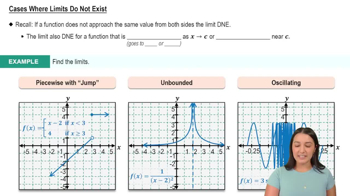
Limits at Infinity

Limits at infinity describe the behavior of a function as the input approaches positive or negative infinity. This concept is crucial for understanding how functions behave in extreme cases, allowing us to determine horizontal asymptotes. For example, if the limit of f(x) as x approaches infinity is a constant, it indicates that the function approaches that constant value, suggesting a horizontal asymptote.
Video consigliato:
03:07
Cases Where Limits Do Not Exist

Horizontal Asymptotes

Horizontal asymptotes are lines that a graph approaches as x approaches infinity or negative infinity. They provide insight into the end behavior of a function. If a function has a horizontal asymptote at y = c, it means that as x becomes very large or very small, the function's value gets closer to c, indicating stability in the function's output at extreme values.
Video consigliato:
Percorso guidato
5:50
Asymptotes of Hyperbolas

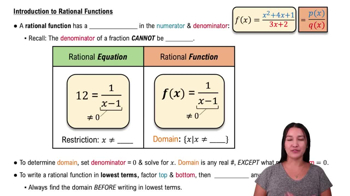
Rational Functions

Rational functions are ratios of polynomials, expressed in the form f(x) = P(x)/Q(x), where P and Q are polynomials. The degrees of these polynomials play a significant role in determining the limits at infinity and the existence of horizontal asymptotes. For instance, if the degree of the numerator is greater than the degree of the denominator, the limit as x approaches infinity will be infinite, indicating no horizontal asymptote.
Video consigliato:
6:04
Intro to Rational Functions