Ch. 2 - Limits
Briggs - Calculus: Early Transcendentals 3rd Edition
Briggs3rd EditionCalculus: Early TranscendentalsISBN: 9780136847243Non è quello che usi tu?Cambia libro di testo
Capitolo 2, Problema 2.22

Determine the following limits. 
lim x→−∞ (3x7 + x2) 

Guida verificata passo dopo passo
1
Identify the dominant term in the expression as \(x\) approaches \(-\infty\). In this case, the dominant term is \(3x^7\) because it has the highest power.
Consider the behavior of the dominant term \(3x^7\) as \(x\) approaches \(-\infty\). Since the exponent is odd, \(3x^7\) will tend towards \(-\infty\).
Recognize that the term \(x^2\) becomes negligible compared to \(3x^7\) as \(x\) approaches \(-\infty\).
Conclude that the limit of the entire expression \(3x^7 + x^2\) is determined by the behavior of the dominant term \(3x^7\).
Therefore, the limit \(\lim_{x \to -\infty} (3x^7 + x^2)\) is the same as \(\lim_{x \to -\infty} 3x^7\), which tends towards \(-\infty\).

Risposta video verificata per un problema simile:

Questa soluzione video è stata consigliata dai nostri tutor come utile per risolvere questo problema.
Durata del video:
3m

Concetti chiave

Ecco i concetti essenziali che devi comprendere per rispondere correttamente alla domanda.

Limits at Infinity

Limits at infinity involve evaluating the behavior of a function as the input approaches positive or negative infinity. This concept is crucial for understanding how polynomial functions behave for very large or very small values of x. In this case, we analyze how the dominant term in the polynomial influences the limit as x approaches negative infinity.
Video consigliato:
05:50
One-Sided Limits

Dominant Term

In polynomial functions, the dominant term is the term with the highest degree, as it has the most significant impact on the function's value for large magnitudes of x. For the limit in question, the term 3x^7 is the dominant term, and it will dictate the behavior of the function as x approaches negative infinity, overshadowing the lower degree term x^2.
Video consigliato:
2:02
Simplifying Trig Expressions Example 1

Polynomial Behavior

Understanding polynomial behavior is essential for evaluating limits. Polynomials are continuous and smooth functions, and their end behavior can be predicted based on the leading term. In this case, since the leading term is of odd degree and has a negative coefficient when x approaches negative infinity, the overall limit will trend towards negative infinity.
Video consigliato:
6:04
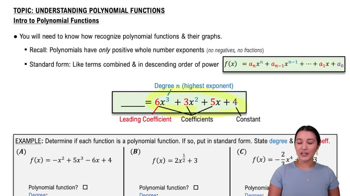
Introduction to Polynomial Functions