Ch. 2 - Limits
Briggs - Calculus: Early Transcendentals 3rd Edition
Briggs3rd EditionCalculus: Early TranscendentalsISBN: 9780136847243Non è quello che usi tu?Cambia libro di testo
Capitolo 2, Problema 2.50

Determine the following limits.
limt→∞cos(t)e3t{\(\displaystyle\[\lim\)_{t\(\to\]\infty\)}\(\frac{\cos\left(t\right)}{e^{3t}\)}}

Guida verificata passo dopo passo
1
Identify the limit expression: \( \lim_{t \to \infty} \frac{\cos(t)}{e^{3t}} \).
Recognize that \( \cos(t) \) oscillates between -1 and 1 for all \( t \).
Observe that \( e^{3t} \) grows exponentially as \( t \to \infty \).
Consider the behavior of the fraction: as the denominator \( e^{3t} \) becomes very large, the fraction \( \frac{\cos(t)}{e^{3t}} \) approaches zero.
Conclude that the limit is zero because the exponential growth in the denominator dominates the bounded oscillation of the numerator.

Risposta video verificata per un problema simile:

Questa soluzione video è stata consigliata dai nostri tutor come utile per risolvere questo problema.
Durata del video:
2m

Concetti chiave

Ecco i concetti essenziali che devi comprendere per rispondere correttamente alla domanda.

Limits at Infinity

Limits at infinity involve evaluating the behavior of a function as the variable approaches infinity. In this context, we analyze how the function behaves when 't' becomes very large. Understanding this concept is crucial for determining whether the limit converges to a finite value, diverges, or approaches zero.
Video consigliato:
05:50
One-Sided Limits

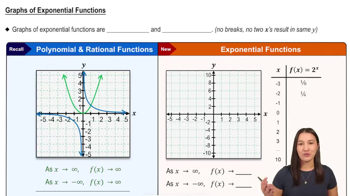
Behavior of Exponential Functions

Exponential functions, such as e^(3t), grow significantly faster than trigonometric functions like cosine(t) as 't' approaches infinity. This rapid growth means that even though cosine oscillates between -1 and 1, the denominator will dominate the fraction, leading to a limit of zero. Recognizing this behavior is essential for solving the limit problem.
Video consigliato:
5:46
Graphs of Exponential Functions

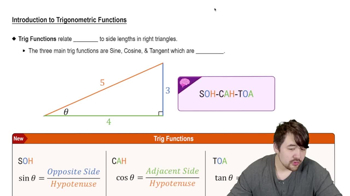
Trigonometric Functions and Boundedness

Trigonometric functions, such as cosine, are bounded, meaning they have a fixed range of values (between -1 and 1). This property is important when evaluating limits because it indicates that the numerator will not grow indefinitely, allowing us to compare it effectively with the rapidly increasing denominator in the limit expression.
Video consigliato:
Percorso guidato
6:04
Introduction to Trigonometric Functions