Ch. 2 - Limits
Briggs - Calculus: Early Transcendentals 3rd Edition
Briggs3rd EditionCalculus: Early TranscendentalsISBN: 9780136847243Non è quello che usi tu?Cambia libro di testo
Capitolo 2, Problema 2.13

Determine the following limits at infinity.


lim t→∞ et,lim t→−∞ e^t,and lim t→∞ e^−t

Guida verificata passo dopo passo
1
Consider the function \(e^t\). As \(t\) approaches infinity, \(e^t\) grows exponentially without bound. Therefore, \(\lim_{t \to \infty} e^t = \infty\).
Now, consider the function \(e^t\) as \(t\) approaches negative infinity. As \(t\) becomes more negative, \(e^t\) approaches zero because the exponential function decays rapidly. Therefore, \(\lim_{t \to -\infty} e^t = 0\).
Next, consider the function \(e^{-t}\) as \(t\) approaches infinity. Notice that \(e^{-t} = \frac{1}{e^t}\). As \(t\) becomes very large, \(e^t\) becomes very large, making \(\frac{1}{e^t}\) approach zero. Therefore, \(\lim_{t \to \infty} e^{-t} = 0\).

Risposta video verificata per un problema simile:

Questa soluzione video è stata consigliata dai nostri tutor come utile per risolvere questo problema.
Durata del video:
5m

Concetti chiave

Ecco i concetti essenziali che devi comprendere per rispondere correttamente alla domanda.

Limits at Infinity

Limits at infinity refer to the behavior of a function as the input approaches positive or negative infinity. Understanding these limits helps determine the end behavior of functions, which is crucial in calculus for analyzing asymptotic behavior and graphing functions.
Video consigliato:
05:50
One-Sided Limits

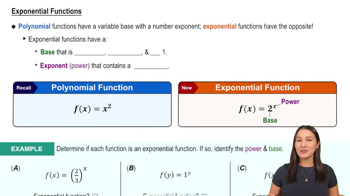
Exponential Functions

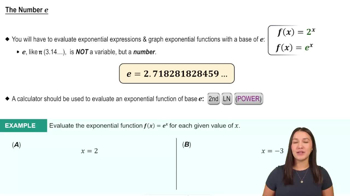
Exponential functions, such as e^t, are functions of the form f(t) = a^t, where 'a' is a positive constant. The base 'e' (approximately 2.718) is particularly important in calculus due to its unique properties, including its derivative being equal to the function itself, which simplifies many calculations involving growth and decay.
Video consigliato:
6:13
Exponential Functions

Behavior of e^t and e^−t

The function e^t grows rapidly as t approaches infinity, leading to a limit of infinity. Conversely, e^−t approaches zero as t approaches infinity, indicating decay. Understanding these behaviors is essential for evaluating the specified limits and interpreting their implications in various contexts.
Video consigliato:
4:47
The Number e