Ch. 2 - Limits
Briggs - Calculus: Early Transcendentals 3rd Edition
Briggs3rd EditionCalculus: Early TranscendentalsISBN: 9780136847243Non è quello che usi tu?Cambia libro di testo
Capitolo 2, Problema 2.36

Determine the following limits.
lim x→∞ (x4 − 1) / (x5 + 2)

Guida verificata passo dopo passo
1
Identify the highest power of x in both the numerator and the denominator. Here, the highest power in the numerator is x^4 and in the denominator is x^5.
Divide every term in the numerator and the denominator by x^5, the highest power of x in the denominator.
Rewrite the expression: (x^4/x^5 - 1/x^5) / (x^5/x^5 + 2/x^5).
Simplify the expression: (1/x - 1/x^5) / (1 + 2/x^5).
Evaluate the limit as x approaches infinity. As x approaches infinity, terms with x in the denominator approach zero, simplifying the expression to 0/1.

Risposta video verificata per un problema simile:

Questa soluzione video è stata consigliata dai nostri tutor come utile per risolvere questo problema.
Durata del video:
3m

Concetti chiave

Ecco i concetti essenziali che devi comprendere per rispondere correttamente alla domanda.

Limits at Infinity

Limits at infinity involve evaluating the behavior of a function as the input approaches infinity. This concept is crucial for understanding how functions behave for very large values of x, which can help determine horizontal asymptotes and the end behavior of polynomial functions.
Video consigliato:
05:50
One-Sided Limits

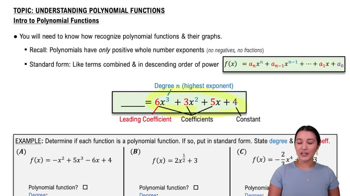
Polynomial Functions

Polynomial functions are expressions that consist of variables raised to non-negative integer powers, combined using addition, subtraction, and multiplication. In the given limit, both the numerator and denominator are polynomials, and their degrees play a significant role in determining the limit's value as x approaches infinity.
Video consigliato:
6:04
Introduction to Polynomial Functions

Dominant Term

The dominant term in a polynomial is the term with the highest degree, which significantly influences the function's behavior as x approaches infinity. In the limit provided, identifying the dominant terms in both the numerator and denominator allows for simplification and accurate evaluation of the limit.
Video consigliato:
2:02
Simplifying Trig Expressions Example 1
Pratica correlata
Domanda del libro di testo

Determine limx→∞f(x)\(\lim\)_{x\(\rightarrow\)\(\infty\)}f\(\left\)(x\(\right\)) and limx→−∞f(x)\(\lim\)_{x\(\rightarrow\)-\(\infty\)}f\(\left\)(x\(\right\)) for the following functions. Then give the horizontal asymptotes of ff (if any).


f(x)=12x4−4x8−9x4f\(\left\)(x\(\right\))=\(\frac{1}{2x^4-\sqrt{4x^8-9x^4}\)}

327
views
Domanda del libro di testo

Evaluate each limit and justify your answer. 

lim x→∞(2x+1x / x)^3

350
views
Domanda del libro di testo

Use the precise definition of a limit to prove the following limits. Specify a relationship between ε and δ that guarantees the limit exists.

lim x→0 x^2=0 (Hint: Use the identity √x2=|x|.)

357
views
Domanda del libro di testo

If a function f represents a system that varies in time, the existence of lim limt→∞f(t){\(\displaystyle\[\lim\)_{t\(\rightarrow\]\infty\)}{f(t)}} means that the system reaches a steady state (or equilibrium). For the following systems, determine whether a steady state exists and give the steady-state value.


The population of a culture of tumor cells is given by p(t)=3500tt+1p\(\left\)(t\(\right\))=\(\frac{3500t}{t+1}\).

373
views
Domanda del libro di testo

Find polynomials p and q such that f=p/q is undefined at 1 and 2, but f has a vertical asymptote only at 2. Sketch a graph of your function.

377
views
Domanda del libro di testo

Determine the following limits.


limx→0x3−5x2x2{\(\displaystyle\)\(\lim\)_{x\(\to\)0}}\(\frac{x^3-5x^2}{x^2}\)

298
views