Ch. 2 - Limits
Briggs - Calculus: Early Transcendentals 3rd Edition
Briggs3rd EditionCalculus: Early TranscendentalsISBN: 9780136847243Non è quello che usi tu?Cambia libro di testo
Capitolo 2, Problema 2.6.36

Evaluate each limit and justify your answer. 
lim x→∞(2x+1x / x)^3

Guida verificata passo dopo passo
1
Step 1: Simplify the expression inside the limit. Start by rewriting the expression (2x + 1x) / x as (2x + x) / x.
Step 2: Simplify the expression further. Combine like terms in the numerator to get 3x / x.
Step 3: Simplify the fraction 3x / x. Since x is not zero, this simplifies to 3.
Step 4: Substitute the simplified expression back into the limit. The limit becomes lim x→∞ (3)^3.
Step 5: Evaluate the limit. Since 3 is a constant, the limit of a constant as x approaches infinity is simply the constant itself. Therefore, the limit is 3^3.

Risposta video verificata per un problema simile:

Questa soluzione video è stata consigliata dai nostri tutor come utile per risolvere questo problema.
Durata del video:
2m

Concetti chiave

Ecco i concetti essenziali che devi comprendere per rispondere correttamente alla domanda.

Limits at Infinity

Limits at infinity involve evaluating the behavior of a function as the input approaches infinity. This concept is crucial for understanding how functions behave for very large values of x, which can often simplify complex expressions. In this case, we analyze how the terms in the expression grow relative to each other as x becomes infinitely large.
Video consigliato:
05:50
One-Sided Limits

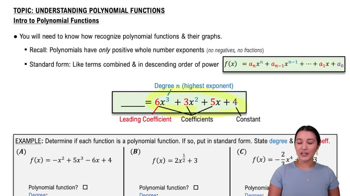
Polynomial Growth

Polynomial growth refers to how polynomial functions behave as their variable approaches infinity. In the expression given, the highest degree term dominates the behavior of the function. Recognizing which terms are significant in the limit helps in simplifying the expression to find the limit more easily.
Video consigliato:
6:04
Introduction to Polynomial Functions

Simplifying Rational Expressions

Simplifying rational expressions involves reducing fractions to their simplest form, which can make evaluating limits more straightforward. In this limit problem, simplifying the expression before taking the limit allows for easier computation and clearer insight into the function's behavior as x approaches infinity.
Video consigliato:
6:36
Simplifying Trig Expressions