Ch. 2 - Limits
Briggs - Calculus: Early Transcendentals 3rd Edition
Briggs3rd EditionCalculus: Early TranscendentalsISBN: 9780136847243Non è quello che usi tu?Cambia libro di testo
Capitolo 2, Problema 2.4.43

Determine the following limits.


limθ→02+sinθ1−cos2θ{\(\displaystyle\[\lim\)_{\(\theta\]\to\)0}}\(\frac{2+\sin\theta}{1-\cos^2\theta}\)

Guida verificata passo dopo passo
1
Step 1: Recognize that the denominator can be simplified using a trigonometric identity. Recall that \(1 - \cos^2\theta = \sin^2\theta\).
Step 2: Substitute the identity into the limit expression, transforming it into \(\lim_{\theta \to 0} \frac{2 + \sin\theta}{\sin^2\theta}\).
Step 3: Consider using L'Hôpital's Rule, which is applicable when the limit results in an indeterminate form like \(\frac{0}{0}\).
Step 4: Differentiate the numerator and the denominator separately. The derivative of the numerator \(2 + \sin\theta\) is \(\cos\theta\), and the derivative of the denominator \(\sin^2\theta\) is \(2\sin\theta\cos\theta\).
Step 5: Apply L'Hôpital's Rule to find the limit: \(\lim_{\theta \to 0} \frac{\cos\theta}{2\sin\theta\cos\theta}\). Simplify the expression and evaluate the limit as \(\theta\) approaches 0.

Risposta video verificata per un problema simile:

Questa soluzione video è stata consigliata dai nostri tutor come utile per risolvere questo problema.
Durata del video:
3m

Concetti chiave

Ecco i concetti essenziali che devi comprendere per rispondere correttamente alla domanda.

Limits

Limits are fundamental in calculus, representing the value that a function approaches as the input approaches a certain point. In this context, we are interested in the limit of a function as theta approaches 0. Understanding limits is crucial for evaluating the behavior of functions near specific points, especially when direct substitution may lead to indeterminate forms.
Video consigliato:
05:50
One-Sided Limits

Trigonometric Functions

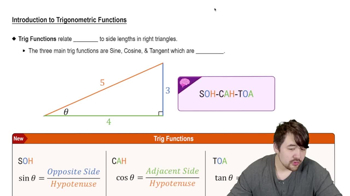
Trigonometric functions, such as sine and cosine, are periodic functions that relate angles to ratios of sides in right triangles. In this limit problem, the sine and cosine functions are evaluated at theta, which approaches 0. Familiarity with the values of these functions at key angles, particularly their behavior near 0, is essential for simplifying the limit expression.
Video consigliato:
Percorso guidato
6:04
Introduction to Trigonometric Functions

Indeterminate Forms

Indeterminate forms occur in calculus when direct substitution into a limit results in expressions like 0/0 or ∞/∞. In this case, substituting theta = 0 into the limit expression leads to an indeterminate form, necessitating further analysis or algebraic manipulation to resolve. Recognizing and handling these forms is vital for correctly evaluating limits.
Video consigliato:
3:56
Slope-Intercept Form
Pratica correlata
Domanda del libro di testo

Use the precise definition of a limit to prove the following limits. Specify a relationship between ε and δ that guarantees the limit exists.

lim x→1 x^4=1

406
views

Domanda del libro di testo

Determine the interval(s) on which the following functions are continuous. 

f(x)=1 / x^2−4

320
views
Domanda del libro di testo

If a function f represents a system that varies in time, the existence of lim limt→∞f(t){\(\displaystyle\[\lim\)_{t\(\rightarrow\]\infty\)}{f(t)}} means that the system reaches a steady state (or equilibrium). For the following systems, determine whether a steady state exists and give the steady-state value.


The population of a bacteria culture is given by p(t)=2500t+1p\(\left\)(t\(\right\))=\(\frac{2500}{t+1}\).

400
views
Domanda del libro di testo

A sequence is an infinite, ordered list of numbers that is often defined by a function. For example, the sequence {2,4,6,8,…} is specified by the function f(n) = 2n, where n=1,2,3,….The limit of such a sequence is lim n→∞ f(n), provided the limit exists. All the limit laws for limits at infinity may be applied to limits of sequences. Find the limit of the following sequences or state that the limit does not exist. 


{2,3/4,4/9,5/16,…}, which is defined by f(n) = (n+1) / n^2, for n=1,2,3,…

308
views
Domanda del libro di testo

Determine the points on the interval (0, 5) at which the following functions f have discontinuities. At each point of discontinuity, state the conditions in the continuity checklist that are violated. <IMAGE>

246
views
Domanda del libro di testo

Determine limx→∞f(x)\(\lim\)_{x\(\rightarrow\)\(\infty\)}f\(\left\)(x\(\right\)) and limx→−∞f(x)\(\lim\)_{x\(\rightarrow\)-\(\infty\)}f\(\left\)(x\(\right\)) for the following functions. Then give the horizontal asymptotes of ff (if any).


f(x)=4x3+12x3+16x6+1f\(\left\)(x\(\right\))=\(\frac{4x^3+1}{2x^3+\sqrt{16x^6+1}\)}

320
views