Ch. 2 - Limits
Briggs - Calculus: Early Transcendentals 3rd Edition
Briggs3rd EditionCalculus: Early TranscendentalsISBN: 9780136847243Non è quello che usi tu?Cambia libro di testo
Capitolo 2, Problema 2.5.47

Determine limx→∞f(x)\(\lim\)_{x\(\rightarrow\)\(\infty\)}f\(\left\)(x\(\right\)) and limx→−∞f(x)\(\lim\)_{x\(\rightarrow\)-\(\infty\)}f\(\left\)(x\(\right\)) for the following functions. Then give the horizontal asymptotes of ff (if any).


f(x)=4x3+12x3+16x6+1f\(\left\)(x\(\right\))=\(\frac{4x^3+1}{2x^3+\sqrt{16x^6+1}\)}

Guida verificata passo dopo passo
1
First, identify the highest power of x in both the numerator and the denominator. In the given function f(x) = \(\frac{4x^3+1}{2x^3+\sqrt{16x^6+1}\)}, the highest power of x in the numerator is x^3 and in the denominator is x^3 (from the term \(\sqrt{16x^6+1}\)).
To simplify the expression, divide every term in the numerator and the denominator by x^3, the highest power of x in the denominator.
After dividing, the function becomes f(x) = \(\frac{4 + \frac{1}{x^3}\)}{2 + \(\sqrt{16 + \frac{1}{x^6}\)}}.
Now, evaluate the limit as x approaches infinity. As x approaches infinity, the terms \(\frac{1}{x^3}\) and \(\frac{1}{x^6}\) approach 0. Thus, the function simplifies to \(\frac{4}{2 + \sqrt{16}\)}.
Similarly, evaluate the limit as x approaches negative infinity. The simplification process is the same, and the function again simplifies to \(\frac{4}{2 + \sqrt{16}\)}. Therefore, the horizontal asymptote is y = \(\frac{4}{2 + \sqrt{16}\)}.

Risposta video verificata per un problema simile:

Questa soluzione video è stata consigliata dai nostri tutor come utile per risolvere questo problema.
Durata del video:
9m

Concetti chiave

Ecco i concetti essenziali che devi comprendere per rispondere correttamente alla domanda.

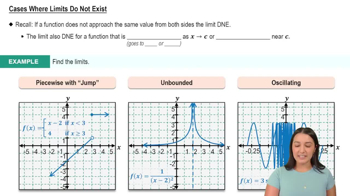
Limits at Infinity

Limits at infinity describe the behavior of a function as the input approaches positive or negative infinity. This concept is crucial for understanding how functions behave in extreme cases, allowing us to determine horizontal asymptotes. For example, if the limit of f(x) as x approaches infinity exists and is a finite number, it indicates that the function approaches a horizontal line at that value.
Video consigliato:
03:07
Cases Where Limits Do Not Exist

Horizontal Asymptotes

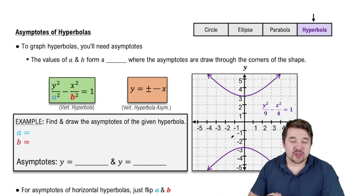
Horizontal asymptotes are lines that a graph approaches as x approaches infinity or negative infinity. They provide insight into the end behavior of a function. If a function has a horizontal asymptote at y = L, it means that as x becomes very large or very small, the function values get closer to L, indicating stability in the function's output at extreme inputs.
Video consigliato:
Percorso guidato
5:50
Asymptotes of Hyperbolas

Rational Functions

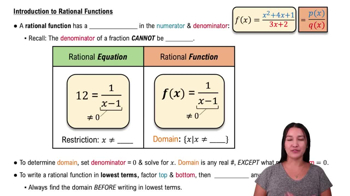
Rational functions are ratios of polynomials, expressed in the form f(x) = P(x)/Q(x), where P and Q are polynomials. The degrees of these polynomials significantly influence the limits at infinity and the existence of horizontal asymptotes. For instance, if the degrees of P and Q are equal, the horizontal asymptote can be found by taking the ratio of their leading coefficients.
Video consigliato:
6:04
Intro to Rational Functions