Ch. 2 - Limits
Briggs - Calculus: Early Transcendentals 3rd Edition
Briggs3rd EditionCalculus: Early TranscendentalsISBN: 9780136847243Non è quello che usi tu?Cambia libro di testo
Capitolo 2, Problema 2.5.63c

Determine whether the following statements are true and give an explanation or counterexample.


c. The graph of a function can have any number of vertical asymptotes but at most two horizontal asymptotes.

Guida verificata passo dopo passo
1
Step 1: Understand the concept of vertical asymptotes. A vertical asymptote occurs at a value of x where a function approaches infinity or negative infinity. This typically happens when the denominator of a rational function is zero and the numerator is not zero at that point.
Step 2: Recognize that a function can have multiple vertical asymptotes. For example, the function \( f(x) = \frac{1}{(x-1)(x-2)} \) has vertical asymptotes at \( x = 1 \) and \( x = 2 \). There is no theoretical limit to the number of vertical asymptotes a function can have.
Step 3: Understand the concept of horizontal asymptotes. A horizontal asymptote describes the behavior of a function as \( x \) approaches infinity or negative infinity. It is determined by the leading terms of the numerator and denominator in a rational function.
Step 4: Note that a function can have at most two horizontal asymptotes. This is because a function can approach different values as \( x \) approaches positive infinity and negative infinity, but not more than one value in each direction.
Step 5: Conclude that the statement is true. A function can have any number of vertical asymptotes, but it can have at most two horizontal asymptotes, one for each direction of infinity.

Risposta video verificata per un problema simile:

Questa soluzione video è stata consigliata dai nostri tutor come utile per risolvere questo problema.
Durata del video:
4m

Concetti chiave

Ecco i concetti essenziali che devi comprendere per rispondere correttamente alla domanda.

Vertical Asymptotes

Vertical asymptotes occur in the graph of a function when the function approaches infinity or negative infinity as the input approaches a certain value. This typically happens at points where the function is undefined, such as division by zero. A function can have multiple vertical asymptotes, depending on its behavior near these undefined points.
Video consigliato:
Percorso guidato
3:40
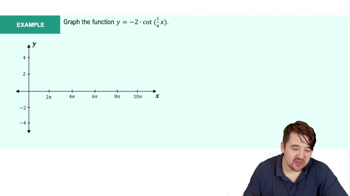
Introduction to Cotangent Graph Example 1

Horizontal Asymptotes

Horizontal asymptotes describe the behavior of a function as the input approaches infinity or negative infinity. They indicate the value that the function approaches but may not necessarily reach. A function can have at most two horizontal asymptotes, one for positive infinity and one for negative infinity, which reflects the end behavior of the function.
Video consigliato:
5:46
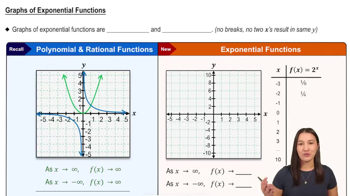
Graphs of Exponential Functions

Function Behavior

Understanding the behavior of a function involves analyzing how it behaves at critical points, including limits, asymptotes, and continuity. This analysis helps in determining the overall shape of the graph and identifying key features such as intercepts and asymptotes. A comprehensive grasp of function behavior is essential for evaluating statements about vertical and horizontal asymptotes.
Video consigliato:
5:46
Graphs of Exponential Functions
Pratica correlata
Domanda del libro di testo

For the following position functions, make a table of average velocities similar to those in Exercises 19–20 and make a conjecture about the instantaneous velocity at the indicated time. 


c. s(t)=40 sin 2t at t=0

370
views

Domanda del libro di testo

Complete the following steps for the given functions. 


c. Graph ff and all of its asymptotes with a graphing utility. Then sketch a graph of the function by hand, correcting any errors appearing in the computer-generated graph.


f(x)=x2−3x+6f\(\left\)(x\(\right\))=\(\frac{x^2-3}{x+6}\)

358
views
Domanda del libro di testo

Complete the following steps for the given functions. 


c. Graph f and all of its asymptotes with a graphing utility. Then sketch a graph of the function by hand, correcting any errors appearing in the computer-generated graph.


f(x)=4x3+4x2+7x+4x2+1f\(\left\)(x\(\right\))=\(\frac{4x^3+4x^2+7x+4}{x^2+1}\)

220
views
Domanda del libro di testo

Complete the following steps for the given functions. 


c. Graph f and all of its asymptotes with a graphing utility. Then sketch a graph of the function by hand, correcting any errors appearing in the computer-generated graph.


f(x)=x2−2x+53x−2f\(\left\)(x\(\right\))=\(\frac{x^2-2x+5}{3x-2}\)

328
views
Domanda del libro di testo

The graph of f in the figure has vertical asymptotes at x=1 and x=2. Analyze the following limits. <IMAGE>

lim x→1 f(x)

259
views
Domanda del libro di testo

The graph of ℎ in the figure has vertical asymptotes at x=−2 and x=3. Analyze the following limits. <IMAGE>

lim x→−2 h(x)

208
views