Ch. 2 - Limits
Briggs - Calculus: Early Transcendentals 3rd Edition
Briggs3rd EditionCalculus: Early TranscendentalsISBN: 9780136847243Non è quello che usi tu?Cambia libro di testo
Capitolo 2, Problema 2.6.33

Evaluate each limit and justify your answer. 
lim x→4 √x^3−2x^2−8x / x−4

Guida verificata passo dopo passo
1
Identify the type of limit: This is a limit of the form \( \frac{0}{0} \) as both the numerator and denominator approach zero when \( x \to 4 \).
Apply L'Hôpital's Rule: Since the limit is of the indeterminate form \( \frac{0}{0} \), we can apply L'Hôpital's Rule, which involves differentiating the numerator and the denominator separately.
Differentiate the numerator: Find the derivative of \( \sqrt{x^3 - 2x^2 - 8x} \) with respect to \( x \). Use the chain rule and power rule for differentiation.
Differentiate the denominator: The derivative of \( x - 4 \) with respect to \( x \) is simply 1.
Evaluate the new limit: Substitute \( x = 4 \) into the new expression obtained after applying L'Hôpital's Rule and simplify to find the limit.

Risposta video verificata per un problema simile:

Questa soluzione video è stata consigliata dai nostri tutor come utile per risolvere questo problema.
Durata del video:
3m

Concetti chiave

Ecco i concetti essenziali che devi comprendere per rispondere correttamente alla domanda.

Limits

A limit is a fundamental concept in calculus that describes the behavior of a function as its input approaches a certain value. It helps in understanding how functions behave near points of interest, including points where they may not be defined. Evaluating limits often involves techniques such as substitution, factoring, or applying L'Hôpital's rule when dealing with indeterminate forms.
Video consigliato:
05:50
One-Sided Limits

Indeterminate Forms

Indeterminate forms occur when direct substitution in a limit leads to expressions like 0/0 or ∞/∞, which do not provide clear information about the limit's value. In such cases, further analysis is required, often involving algebraic manipulation or L'Hôpital's rule, which allows for differentiation of the numerator and denominator to resolve the limit.
Video consigliato:
3:56
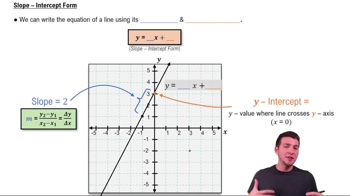
Slope-Intercept Form

Factoring and Simplification

Factoring and simplification are techniques used to rewrite expressions in a more manageable form, especially when evaluating limits. By factoring out common terms or simplifying complex expressions, one can often eliminate indeterminate forms and make it easier to compute the limit. This process is crucial in finding the limit of rational functions or polynomials.
Video consigliato:
03:45
Critical Points Example 1