Ch. 2 - Limits
Briggs - Calculus: Early Transcendentals 3rd Edition
Briggs3rd EditionCalculus: Early TranscendentalsISBN: 9780136847243Non è quello che usi tu?Cambia libro di testo
Capitolo 2, Problema 2.7.46

Use the precise definition of infinite limits to prove the following limits.


limx→−11(x+1)4=∞{\(\displaystyle\)\(\lim\)_{x\(\to\)-1}}\(\frac{1}{\left(x+1\right)^4}\)=\(\infty\)

Guida verificata passo dopo passo
1
Step 1: Understand the definition of an infinite limit. The statement \( \lim_{x \to -1} \frac{1}{(x+1)^4} = \infty \) means that for every positive number \( M \), there exists a \( \delta > 0 \) such that if \( 0 < |x + 1| < \delta \), then \( \frac{1}{(x+1)^4} > M \).
Step 2: Analyze the function \( \frac{1}{(x+1)^4} \). As \( x \) approaches \( -1 \), the expression \( (x+1)^4 \) approaches 0, making \( \frac{1}{(x+1)^4} \) grow larger without bound.
Step 3: Set up the inequality \( \frac{1}{(x+1)^4} > M \) to find \( \delta \). This inequality can be rewritten as \( (x+1)^4 < \frac{1}{M} \).
Step 4: Solve \( (x+1)^4 < \frac{1}{M} \) for \( |x+1| \). Take the fourth root of both sides to get \( |x+1| < \frac{1}{M^{1/4}} \).
Step 5: Conclude that for any \( M > 0 \), choosing \( \delta = \frac{1}{M^{1/4}} \) ensures that \( 0 < |x+1| < \delta \) implies \( \frac{1}{(x+1)^4} > M \), thus proving the limit.

Risposta video verificata per un problema simile:

Questa soluzione video è stata consigliata dai nostri tutor come utile per risolvere questo problema.
Durata del video:
5m

Concetti chiave

Ecco i concetti essenziali che devi comprendere per rispondere correttamente alla domanda.

Infinite Limits

Infinite limits describe the behavior of a function as the input approaches a certain value, leading the output to grow without bound. Specifically, if the limit of a function as x approaches a value c is infinity, it indicates that the function's values increase indefinitely as x gets closer to c. This concept is crucial for understanding how functions behave near vertical asymptotes.
Video consigliato:
05:50
One-Sided Limits

Limit Definition

The precise definition of a limit involves the formal epsilon-delta approach, which provides a rigorous way to describe how a function behaves as it approaches a specific point. For infinite limits, this means that for every large number M, there exists a delta such that if the distance between x and c is less than delta, the function's value exceeds M. This definition is essential for proving limits rigorously.
Video consigliato:
05:50
One-Sided Limits

Polynomial Behavior Near Roots

Understanding how polynomials behave near their roots is vital for analyzing limits. In the case of the limit in question, the expression (x + 1)^4 approaches zero as x approaches -1, causing the overall fraction to approach infinity. Recognizing that higher powers of polynomials lead to faster growth or decay helps in predicting the behavior of functions near critical points.
Video consigliato:
6:04
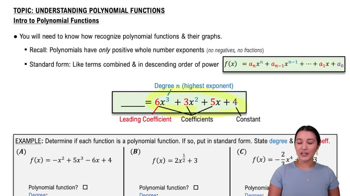
Introduction to Polynomial Functions