Ch. 2 - Limits
Briggs - Calculus: Early Transcendentals 3rd Edition
Briggs3rd EditionCalculus: Early TranscendentalsISBN: 9780136847243Non è quello che usi tu?Cambia libro di testo
Capitolo 2, Problema 2.4.48

Find all vertical asymptotes x=ax=a of the following functions. For each value of aa, determine limx→a+f(x){\(\displaystyle\)\(\lim\)_{x\(\to\) a^{+}}}f\(\left\)(x\(\right\)), limx→a−f(x){\(\displaystyle\)\(\lim\)_{x\(\to\) a^{-}}}f\(\left\)(x\(\right\)), and limx→af(x){\(\displaystyle\)\(\lim\)_{x\(\to\) a}}f\(\left\)(x\(\right\)).
f(x)=cos(x)x2+2xf\(\left\)(x\(\right\))=\(\frac{\cos\left(x\right)}{x^2+2x}\)

Guida verificata passo dopo passo
1
Step 1: Identify the points where the denominator of the function is zero, as these are potential vertical asymptotes. For the function \( f(x) = \frac{\cos(x)}{x^2 + 2x} \), set the denominator equal to zero: \( x^2 + 2x = 0 \).
Step 2: Solve the equation \( x^2 + 2x = 0 \) by factoring. Factor out an \( x \) to get \( x(x + 2) = 0 \). This gives the solutions \( x = 0 \) and \( x = -2 \).
Step 3: Determine the behavior of the function as \( x \) approaches each of these values from the left and right. For \( x = 0 \), evaluate \( \lim_{x \to 0^+} f(x) \) and \( \lim_{x \to 0^-} f(x) \).
Step 4: Similarly, evaluate the limits for \( x = -2 \). Calculate \( \lim_{x \to -2^+} f(x) \) and \( \lim_{x \to -2^-} f(x) \).
Step 5: Analyze the results of these limits. If the one-sided limits approach \( \pm \infty \), then \( x = 0 \) and \( x = -2 \) are vertical asymptotes. If the two-sided limit \( \lim_{x \to a} f(x) \) does not exist or is infinite, it confirms the presence of a vertical asymptote at \( x = a \).

Risposta video verificata per un problema simile:

Questa soluzione video è stata consigliata dai nostri tutor come utile per risolvere questo problema.
Durata del video:
7m

Concetti chiave

Ecco i concetti essenziali che devi comprendere per rispondere correttamente alla domanda.

Vertical Asymptotes

Vertical asymptotes occur in a function when the output approaches infinity as the input approaches a certain value. This typically happens when the function's denominator approaches zero while the numerator remains non-zero. To find vertical asymptotes, we identify values of x that make the denominator zero and check the behavior of the function as x approaches these values from both sides.
Video consigliato:
Percorso guidato
3:40
Introduction to Cotangent Graph Example 1

Limits

Limits are fundamental in calculus, representing the value that a function approaches as the input approaches a certain point. In the context of vertical asymptotes, we evaluate the limits of the function as x approaches the asymptote from the left (denoted as x → a⁻) and from the right (denoted as x → a⁺). The behavior of these limits helps determine whether the function indeed has a vertical asymptote at that point.
Video consigliato:
05:50
One-Sided Limits

Continuous Functions

A function is continuous at a point if the limit of the function as it approaches that point equals the function's value at that point. For vertical asymptotes, the function is not continuous at the asymptote since the limit approaches infinity or does not exist. Understanding continuity is crucial for analyzing the behavior of functions near points of discontinuity, such as vertical asymptotes.
Video consigliato:
05:34
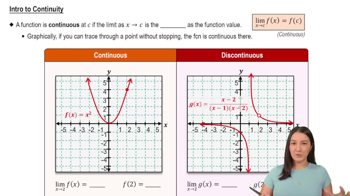
Intro to Continuity