Ch. 2 - Limits
Briggs - Calculus: Early Transcendentals 3rd Edition
Briggs3rd EditionCalculus: Early TranscendentalsISBN: 9780136847243Non è quello che usi tu?Cambia libro di testo
Capitolo 2, Problema 2.19

Determine the following limits.
lim x→3 1/ x − 3(1 /√x + 1 − 1/2)

Guida verificata passo dopo passo
1
Identify the limit expression: \( \lim_{{x \to 3}} \left( \frac{1}{x - 3} \left( \frac{1}{\sqrt{x + 1}} - \frac{1}{2} \right) \right) \).
Notice that direct substitution of \( x = 3 \) results in an indeterminate form \( \frac{0}{0} \).
To resolve the indeterminate form, consider simplifying the expression inside the limit by finding a common denominator for the terms inside the parentheses.
The common denominator for \( \frac{1}{\sqrt{x + 1}} \) and \( \frac{1}{2} \) is \( 2\sqrt{x + 1} \). Rewrite the expression as \( \frac{2 - \sqrt{x + 1}}{2\sqrt{x + 1}} \).
Multiply the numerator and the denominator by the conjugate of the numerator, \( 2 + \sqrt{x + 1} \), to rationalize the expression and simplify further.

Risposta video verificata per un problema simile:

Questa soluzione video è stata consigliata dai nostri tutor come utile per risolvere questo problema.
Durata del video:
5m

Concetti chiave

Ecco i concetti essenziali che devi comprendere per rispondere correttamente alla domanda.

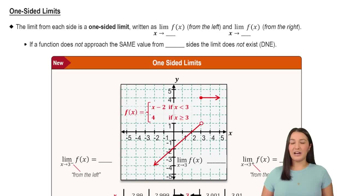
Limits

A limit is a fundamental concept in calculus that describes the behavior of a function as its input approaches a certain value. It helps in understanding how functions behave near points of interest, including points where they may not be defined. In this question, evaluating the limit as x approaches 3 is crucial for determining the function's value at that point.
Video consigliato:
05:50
One-Sided Limits

Indeterminate Forms

Indeterminate forms occur in calculus when direct substitution in a limit leads to expressions like 0/0 or ∞/∞, which do not provide clear information about the limit's value. Recognizing these forms is essential for applying techniques such as L'Hôpital's Rule or algebraic manipulation to resolve the limit. In this case, the expression may lead to an indeterminate form, necessitating further analysis.
Video consigliato:
3:56
Slope-Intercept Form

Rational Functions

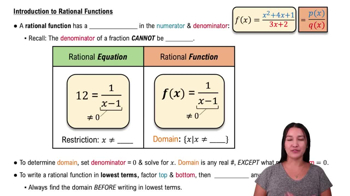
Rational functions are ratios of polynomials, and their limits can often be evaluated by simplifying the expression. Understanding how to manipulate these functions, including factoring and canceling common terms, is vital for finding limits. In the given limit problem, recognizing the structure of the rational function will aid in simplifying the expression before evaluating the limit.
Video consigliato:
6:04
Intro to Rational Functions
Pratica correlata
Domanda del libro di testo

Determine limx→∞f(x)\(\lim\)_{x\(\rightarrow\)\(\infty\)}f\(\left\)(x\(\right\)) and limx→−∞f(x)\(\lim\)_{x\(\rightarrow\)-\(\infty\)}f\(\left\)(x\(\right\)) for the following functions. Then give the horizontal asymptotes of ff (if any).


f(x)=x6+834x2+3x4+1f\(\left\)(x\(\right\))=\(\frac{\sqrt[3]{x^6+8}\)}{4x^2+\(\sqrt{3x^4+1}\)}

323
views
Domanda del libro di testo

Complete the following steps for each function.


c. State the interval(s) of continuity.


f(x)={2x if x<1

x^2+3x if x≥1; a=1

347
views
Domanda del libro di testo

Evaluate f(3) if lim x→3^− f(x)=5,lim x→3^+ f(x)=6, and f is right-continuous at x=3.

347
views
Domanda del libro di testo

Find all vertical asymptotes x=ax=a of the following functions. For each value of aa, determine limx→a+f(x){\(\displaystyle\)\(\lim\)_{x\(\to\) a^{+}}}f\(\left\)(x\(\right\)), limx→a−f(x){\(\displaystyle\)\(\lim\)_{x\(\to\) a^{-}}}f\(\left\)(x\(\right\)), and limx→af(x){\(\displaystyle\)\(\lim\)_{x\(\to\) a}}f\(\left\)(x\(\right\)).

f(x)=cos(x)x2+2xf\(\left\)(x\(\right\))=\(\frac{\cos\left(x\right)}{x^2+2x}\)

348
views
Domanda del libro di testo

Determine the following limits. 


lim x→∞ x^4+7 / x^5+x^2−x

332
views
Domanda del libro di testo

Determine the end behavior of the following transcendental functions by analyzing appropriate limits. Then provide a simple sketch of the associated graph, showing asymptotes if they exist. 

f(x)=−3e−xf\(\left\)(x\(\right\))=-3e^{-x}

358
views