Ch. 2 - Limits
Briggs - Calculus: Early Transcendentals 3rd Edition
Briggs3rd EditionCalculus: Early TranscendentalsISBN: 9780136847243Non è quello che usi tu?Cambia libro di testo
Capitolo 2, Problema 2.3.59

Find the following limits or state that they do not exist. Assume a, b, c, and k are fixed real numbers.


limx→∞xcos(x){\(\displaystyle\)\(\lim\)_{x\(\to\[\infty\)}{x\(\cos\]\left\)(x\(\right\))}}

Guida verificata passo dopo passo
1
Recognize that the limit involves an oscillating function, \( \cos(x) \), which oscillates between -1 and 1.
Consider the behavior of \( x \cos(x) \) as \( x \to \infty \). The term \( x \) grows without bound, while \( \cos(x) \) continues to oscillate.
Use the Squeeze Theorem to analyze the limit. Since \( -1 \leq \cos(x) \leq 1 \), it follows that \( -x \leq x \cos(x) \leq x \).
Examine the limits of the bounding functions: \( \lim_{x \to \infty} -x = -\infty \) and \( \lim_{x \to \infty} x = \infty \).
Conclude that since the bounding functions tend to \( -\infty \) and \( \infty \), the limit \( \lim_{x \to \infty} x \cos(x) \) does not exist.

Risposta video verificata per un problema simile:

Questa soluzione video è stata consigliata dai nostri tutor come utile per risolvere questo problema.
Durata del video:
1m

Concetti chiave

Ecco i concetti essenziali che devi comprendere per rispondere correttamente alla domanda.

Limits at Infinity

Limits at infinity involve evaluating the behavior of a function as the input approaches infinity. This concept is crucial for understanding how functions behave in extreme cases, particularly for determining whether they approach a finite value, diverge, or oscillate. In this context, we analyze the limit of the function as x approaches infinity to ascertain its long-term behavior.
Video consigliato:
05:50
One-Sided Limits

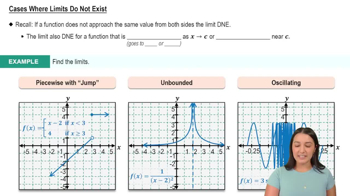
Oscillatory Behavior

Oscillatory behavior refers to functions that do not settle at a single value as their input increases but instead fluctuate between values. The cosine function, for example, oscillates between -1 and 1. When combined with a term that grows without bound, such as x in this limit, it can lead to indeterminate forms, necessitating careful analysis to determine the limit's existence.
Video consigliato:
03:07
Cases Where Limits Do Not Exist

Squeeze Theorem

The Squeeze Theorem is a method used to find limits of functions that are difficult to evaluate directly. It states that if a function is 'squeezed' between two other functions that converge to the same limit, then the squeezed function must also converge to that limit. This theorem is particularly useful in cases where oscillatory functions are involved, as it can help establish the limit's behavior by bounding it.
Video consigliato:
05:12
Finding Global Extrema (Extreme Value Theorem)