Ch. 2 - Limits
Briggs - Calculus: Early Transcendentals 3rd Edition
Briggs3rd EditionCalculus: Early TranscendentalsISBN: 9780136847243Non è quello che usi tu?Cambia libro di testo
Capitolo 2, Problema 2.6.77

Find an interval containing a solution to the equation 2x=cos(x)2x=\(\cos\)\(\left\)(x\(\right\)). Use a graphing utility to approximate the solution.

Guida verificata passo dopo passo
1
Insert step 1: Understand the problem. We need to find an interval where the function f(x) = 2x - \(\cos\)(x) changes sign, indicating a root.
Insert step 2: Consider the behavior of the functions involved. The function 2x is a straight line with a slope of 2, and \(\cos\)(x) is a periodic function oscillating between -1 and 1.
Insert step 3: Set up the equation f(x) = 2x - \(\cos\)(x) and analyze its behavior over a reasonable interval, such as [0, \(\pi\)/2], where \(\cos\)(x) is positive and decreasing.
Insert step 4: Use a graphing utility to plot f(x) = 2x - \(\cos\)(x) over the interval [0, \(\pi\)/2] and look for a sign change, which indicates a root.
Insert step 5: Identify the interval where the graph crosses the x-axis, which will give an approximate interval containing the solution.

Risposta video verificata per un problema simile:

Questa soluzione video è stata consigliata dai nostri tutor come utile per risolvere questo problema.
Durata del video:
2m

Concetti chiave

Ecco i concetti essenziali che devi comprendere per rispondere correttamente alla domanda.

Intermediate Value Theorem

The Intermediate Value Theorem states that if a continuous function takes on two values at two points, it must also take on any value between those two points at least once. This theorem is essential for finding intervals where solutions to equations exist, as it guarantees that if the function changes signs over an interval, there is at least one root in that interval.
Video consigliato:
05:12
Finding Global Extrema (Extreme Value Theorem)

Graphing Functions

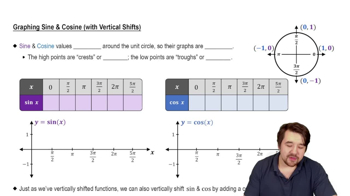
Graphing functions involves plotting the values of a function on a coordinate plane to visualize its behavior. In this context, graphing the functions y = 2x and y = cos(x) allows us to identify points of intersection, which represent the solutions to the equation 2x = cos(x). This visual approach can help approximate the solution and understand the relationship between the two functions.
Video consigliato:
Percorso guidato
5:53
Graph of Sine and Cosine Function

Continuous Functions

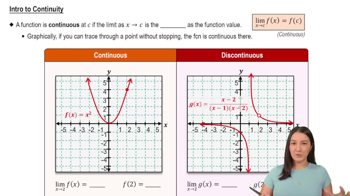
A continuous function is one that does not have any breaks, jumps, or holes in its graph. Both y = 2x and y = cos(x) are continuous functions, which is crucial for applying the Intermediate Value Theorem. Understanding continuity helps in determining the behavior of functions and ensuring that solutions can be found within specified intervals.
Video consigliato:
05:34
Intro to Continuity
Pratica correlata
Domanda del libro di testo

Sketch a possible graph of a function f that satisfies all of the given conditions. Be sure to identify all vertical and horizontal asymptotes.

f(−1)=−2f\(\left\)(-1\(\right\))=-2, f(1)=2f\(\left\)(1\(\right\))=2, f(0)=0f\(\left\)(0\(\right\))=0, limx→∞f(x)=1{\(\displaystyle\[\lim\)_{x\(\to\]\infty\)}{f(x)=1}}, limx→−∞f(x)=−1{\(\displaystyle\)\(\lim\)_{x\(\to\)-\(\infty\)}{f(x)=-1}}

521
views
Domanda del libro di testo

Evaluate each limit and justify your answer. 

lim x→5 ln 6(√x^2−16−3) / 5x−25

362
views
Domanda del libro di testo

Find the following limits or state that they do not exist. Assume a, b, c, and k are fixed real numbers.


limx→∞xcos(x){\(\displaystyle\)\(\lim\)_{x\(\to\[\infty\)}{x\(\cos\]\left\)(x\(\right\))}}

252
views
Domanda del libro di testo

Sketch the graph of a function with the given properties. You do not need to find a formula for the function. 


p(0) = 2,lim x→0 p(x) = 0,lim x→2 p(x) does not exist, p(2)=lim x→2^+ p(x)=1

317
views
Domanda del libro di testo

Determine the following limits.

lim θ→π/2 sin^2 θ − 5 sin θ + 4 / sin^2 θ − 1

367
views
Domanda del libro di testo

Determine limx→∞f(x)\(\lim\)_{x\(\rightarrow\)\(\infty\)}f\(\left\)(x\(\right\)) and limx→−∞f(x)\(\lim\)_{x\(\rightarrow\)-\(\infty\)}f\(\left\)(x\(\right\)) for the following functions. Then give the horizontal asymptotes of ff (if any).


f(x)=4x3+12x3+16x6+1f\(\left\)(x\(\right\))=\(\frac{4x^3+1}{2x^3+\sqrt{16x^6+1}\)}

320
views