Ch. 2 - Limits
Briggs - Calculus: Early Transcendentals 3rd Edition
Briggs3rd EditionCalculus: Early TranscendentalsISBN: 9780136847243Non è quello che usi tu?Cambia libro di testo
Capitolo 2, Problema 2.12a

Graph the function f(x)=e^−x / x(x+2)^2 using a graphing utility. (Experiment with your choice of a graphing window.) Use your graph to determine the following limits.


a. lim x→−2^+ f(x)

Guida verificata passo dopo passo
1
Step 1: Understand the function and its components. The function is \( f(x) = \frac{e^{-x}}{x(x+2)^2} \). It is a rational function with an exponential term in the numerator and a polynomial in the denominator.
Step 2: Identify the point of interest for the limit, which is \( x \to -2^+ \). This means we are approaching \( x = -2 \) from the right side.
Step 3: Analyze the behavior of the denominator as \( x \to -2^+ \). The term \((x+2)^2\) in the denominator approaches zero, which suggests a vertical asymptote at \( x = -2 \).
Step 4: Consider the behavior of the numerator, \( e^{-x} \), as \( x \to -2^+ \). Since \( e^{-x} \) is continuous and positive for all real \( x \), it does not approach zero or infinity.
Step 5: Use a graphing utility to visualize the function \( f(x) \) and observe the behavior as \( x \to -2^+ \). The graph will help confirm whether the limit approaches positive or negative infinity.

Risposta video verificata per un problema simile:

Questa soluzione video è stata consigliata dai nostri tutor come utile per risolvere questo problema.
Durata del video:
1m

Concetti chiave

Ecco i concetti essenziali che devi comprendere per rispondere correttamente alla domanda.

Limits

Limits are fundamental in calculus, representing the value that a function approaches as the input approaches a certain point. In this context, evaluating the limit as x approaches -2 from the right (denoted as -2^+) involves analyzing the behavior of the function f(x) near that point, which can reveal important characteristics such as continuity and potential asymptotes.
Video consigliato:
05:50
One-Sided Limits

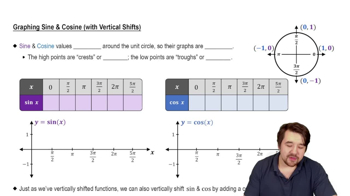
Graphing Functions

Graphing functions involves plotting the values of a function on a coordinate system to visualize its behavior. For the function f(x) = e^(-x) / (x(x+2)^2), using a graphing utility allows for experimentation with different viewing windows, which can help identify key features such as intercepts, asymptotes, and the overall shape of the graph, aiding in the limit evaluation.
Video consigliato:
Percorso guidato
5:53
Graph of Sine and Cosine Function

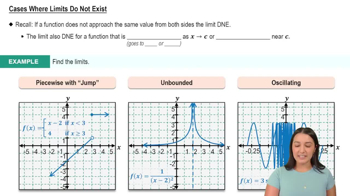
Asymptotic Behavior

Asymptotic behavior refers to how a function behaves as it approaches a certain point or infinity. In the case of f(x) as x approaches -2, understanding whether the function approaches a finite value, diverges to infinity, or oscillates is crucial for determining the limit. This behavior can often be inferred from the graph and the function's algebraic form.
Video consigliato:
03:07
Cases Where Limits Do Not Exist