Ch. 2 - Limits
Briggs - Calculus: Early Transcendentals 3rd Edition
Briggs3rd EditionCalculus: Early TranscendentalsISBN: 9780136847243Non è quello che usi tu?Cambia libro di testo
Capitolo 2, Problema 2.9a

Complete the following sentences in terms of a limit.


a. A function is continuous from the left at a if _____.

Guida verificata passo dopo passo
1
Step 1: Understand the concept of continuity from the left. A function is continuous from the left at a point \( a \) if the left-hand limit of the function as \( x \) approaches \( a \) is equal to the function's value at \( a \).
Step 2: Express the left-hand limit mathematically. The left-hand limit of a function \( f(x) \) as \( x \) approaches \( a \) from the left is denoted as \( \lim_{{x \to a^-}} f(x) \).
Step 3: State the condition for left continuity. For the function \( f(x) \) to be continuous from the left at \( a \), the condition \( \lim_{{x \to a^-}} f(x) = f(a) \) must be satisfied.
Step 4: Consider the implications. This means that as \( x \) gets arbitrarily close to \( a \) from values less than \( a \), the function values \( f(x) \) should approach \( f(a) \).
Step 5: Summarize the sentence. A function is continuous from the left at \( a \) if \( \lim_{{x \to a^-}} f(x) = f(a) \).

Risposta video verificata per un problema simile:

Questa soluzione video è stata consigliata dai nostri tutor come utile per risolvere questo problema.
Durata del video:
1m

Concetti chiave

Ecco i concetti essenziali che devi comprendere per rispondere correttamente alla domanda.

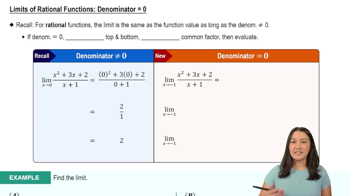
Limit of a Function

The limit of a function describes the value that the function approaches as the input approaches a certain point. It is a fundamental concept in calculus that helps in understanding the behavior of functions near specific points, especially when they are not defined at those points.
Video consigliato:
06:11
Limits of Rational Functions: Denominator = 0

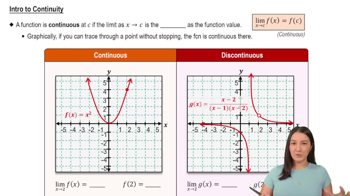
Continuity

A function is continuous at a point if the limit of the function as it approaches that point equals the function's value at that point. This means there are no breaks, jumps, or holes in the graph of the function at that point, ensuring a smooth transition.
Video consigliato:
05:34
Intro to Continuity

One-Sided Limits

One-sided limits refer to the behavior of a function as it approaches a specific point from one side only, either the left or the right. For a function to be continuous from the left at a point 'a', the left-hand limit must equal the function's value at 'a', indicating that the function approaches a specific value as the input approaches 'a' from the left.
Video consigliato:
05:50
One-Sided Limits