Ch. 2 - Limits
Briggs - Calculus: Early Transcendentals 3rd Edition
Briggs3rd EditionCalculus: Early TranscendentalsISBN: 9780136847243Non è quello che usi tu?Cambia libro di testo
Capitolo 2, Problema 14d

The position of an object moving vertically along a line is given by the function s(t)=−4.9t2+30t+20s\(\left\)(t\(\right\))=-4.9t^2+30t+20. Find the average velocity of the object over the following intervals.
[0,h]\(\left\[\lbrack\)0,h\(\right\]\rbrack\), where h>0h\(\gt{0}\) is a real number

Guida verificata passo dopo passo
1
Identify the formula for average velocity over an interval [a, b], which is given by the change in position divided by the change in time: \( v_{avg} = \frac{s(b) - s(a)}{b - a} \).
In this problem, the interval is [0, h], so we need to find the average velocity over this interval. Set \( a = 0 \) and \( b = h \).
Substitute the values into the average velocity formula: \( v_{avg} = \frac{s(h) - s(0)}{h - 0} \).
Calculate \( s(h) \) by substituting \( t = h \) into the position function: \( s(h) = -4.9h^2 + 30h + 20 \).
Calculate \( s(0) \) by substituting \( t = 0 \) into the position function: \( s(0) = -4.9(0)^2 + 30(0) + 20 = 20 \).

Risposta video verificata per un problema simile:

Questa soluzione video è stata consigliata dai nostri tutor come utile per risolvere questo problema.
Durata del video:
3m

Concetti chiave

Ecco i concetti essenziali che devi comprendere per rispondere correttamente alla domanda.

Position Function

The position function describes the location of an object at any given time, represented mathematically as s(t). In this case, the function s(t) = -4.9t² + 30t + 20 models the vertical motion of an object under the influence of gravity, where t is time in seconds. Understanding this function is crucial for analyzing the object's motion and calculating its velocity.
Video consigliato:
Percorso guidato
5:20
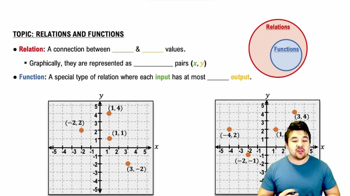
Relations and Functions

Average Velocity

Average velocity is defined as the change in position over the change in time, calculated using the formula (s(b) - s(a)) / (b - a) for an interval [a, b]. In this context, to find the average velocity over the interval [0, h], one would evaluate the position function at the endpoints and apply this formula. This concept is essential for understanding how the object's speed changes over time.
Video consigliato:
Percorso guidato
06:37
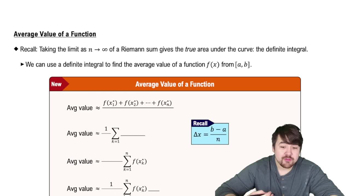
Average Value of a Function

Intervals and Limits

Intervals in calculus refer to the range of values over which a function is analyzed. In this question, the interval [0, h] indicates that we are examining the object's motion from time t = 0 to t = h, where h is a positive real number. Understanding how to work with intervals is important for evaluating functions and determining properties like average velocity over specific time frames.
Video consigliato:
05:50
One-Sided Limits
Pratica correlata
Domanda del libro di testo

Suppose g(x) = {2x+1 if x≠0

5 if x=0.


Compute g(0) and lim x→0 g(x)

359
views

Domanda del libro di testo

Use the graph of f in the figure to find the following values or state that they do not exist. If a limit does not exist, explain why. <IMAGE>

limx→1+f(x)\(\lim\)_{x\(\to\)1^{+}}f\(\left\)(x\(\right\))

354
views
Domanda del libro di testo

The position of an object moving vertically along a line is given by the function s(t)=−4.9t2+30t+20s\(\left\)(t\(\right\))=-4.9t^2+30t+20. Find the average velocity of the object over the following intervals.

[0,3]\(\left\[\lbrack\)0,3\(\right\]\rbrack\)

359
views
Domanda del libro di testo

Determine the following limits.

lim x→a (3x + 1)^2 − (3a + 1)^2 / x − a, where a is constant

348
views
Domanda del libro di testo

Use the graph of f in the figure to find the following values or state that they do not exist. If a limit does not exist, explain why. <IMAGE>

limx→1−f(x)\(\lim\)_{x\(\to\)1^{-}}f\(\left\)(x\(\right\))

390
views
Domanda del libro di testo

Let g(x)=x3−4x8∣x−2∣g\(\left\)(x\(\right\))=\(\frac{x^3-4x}{8\left|x-2\right|}\). <IMAGE>

Make a conjecture about the values of limx→2−g(x){\(\displaystyle\)\(\lim\)_{x\(\to\)2^{-}}g\(\left\)(x\(\right\))}, limx→2+g(x){\(\displaystyle\)\(\lim\)_{x\(\to\)2^{+}}g\(\left\)(x\(\right\))}, and limx→2g(x){\(\displaystyle\)\(\lim\)_{x\(\to\)2}g\(\left\)(x\(\right\))} or state that they do not exist.

358
views