Ch. 2 - Limits
Briggs - Calculus: Early Transcendentals 3rd Edition
Briggs3rd EditionCalculus: Early TranscendentalsISBN: 9780136847243Non è quello che usi tu?Cambia libro di testo
Capitolo 2, Problema 15b

Use the graph of f in the figure to find the following values or state that they do not exist. If a limit does not exist, explain why. <IMAGE>
limx→1−f(x)\(\lim\)_{x\(\to\)1^{-}}f\(\left\)(x\(\right\))

Guida verificata passo dopo passo
1
Identify the point of interest on the graph, which is x = 1, and observe the behavior of the function f(x) as x approaches 1 from the left (x -> 1^-).
Examine the values of f(x) for x slightly less than 1. This involves looking at the graph to see where the function is heading as it gets closer to x = 1 from the left side.
Determine if the function approaches a specific value as x approaches 1 from the left. This is the left-hand limit, denoted as \( \lim_{x \to 1^{-}} f(x) \).
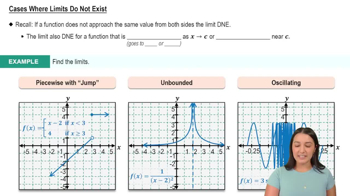
If the function approaches a specific y-value, then that y-value is the left-hand limit. If the function does not approach a specific value (e.g., it jumps or oscillates), then the left-hand limit does not exist.
State the left-hand limit based on the graph's behavior. If it exists, provide the y-value it approaches; if not, explain why it does not exist (e.g., due to a jump discontinuity or oscillation).

Risposta video verificata per un problema simile:

Questa soluzione video è stata consigliata dai nostri tutor come utile per risolvere questo problema.
Durata del video:
1m

Concetti chiave

Ecco i concetti essenziali che devi comprendere per rispondere correttamente alla domanda.

Limits

A limit describes the value that a function approaches as the input approaches a certain point. In this context, we are interested in the left-hand limit, denoted as lim_{x→1^{-}}f(x), which examines the behavior of the function f(x) as x approaches 1 from values less than 1. Understanding limits is crucial for analyzing continuity and the behavior of functions at specific points.
Video consigliato:
05:50
One-Sided Limits

Left-Hand Limit

The left-hand limit refers specifically to the value that a function approaches as the input approaches a certain point from the left side. It is denoted as lim_{x→c^{-}}f(x) for a point c. This concept is essential when determining the overall limit of a function at a point where the function may behave differently from the left and right sides.
Video consigliato:
05:50
One-Sided Limits

Existence of Limits

For a limit to exist at a point, both the left-hand and right-hand limits must approach the same value. If they do not match, or if one or both limits do not exist, we conclude that the limit at that point does not exist. This concept is vital for understanding discontinuities in functions and for providing explanations when limits are found to be non-existent.
Video consigliato:
03:07
Cases Where Limits Do Not Exist
Pratica correlata
Domanda del libro di testo

Suppose g(x) = {2x+1 if x≠0

5 if x=0.


Compute g(0) and lim x→0 g(x)

359
views

Domanda del libro di testo

Use the graph of f in the figure to find the following values or state that they do not exist. If a limit does not exist, explain why. <IMAGE>

limx→1+f(x)\(\lim\)_{x\(\to\)1^{+}}f\(\left\)(x\(\right\))

354
views
Domanda del libro di testo

Suppose p and q are polynomials. If lim x→0 p(x) / q(x)=10 and q(0)=2, find p(0).

279
views
Domanda del libro di testo

Let g(x)=x3−4x8∣x−2∣g\(\left\)(x\(\right\))=\(\frac{x^3-4x}{8\left|x-2\right|}\). <IMAGE>

Make a conjecture about the values of limx→2−g(x){\(\displaystyle\)\(\lim\)_{x\(\to\)2^{-}}g\(\left\)(x\(\right\))}, limx→2+g(x){\(\displaystyle\)\(\lim\)_{x\(\to\)2^{+}}g\(\left\)(x\(\right\))}, and limx→2g(x){\(\displaystyle\)\(\lim\)_{x\(\to\)2}g\(\left\)(x\(\right\))} or state that they do not exist.

358
views
Domanda del libro di testo

The position of an object moving vertically along a line is given by the function s(t)=−4.9t2+30t+20s\(\left\)(t\(\right\))=-4.9t^2+30t+20. Find the average velocity of the object over the following intervals.

[0,h]\(\left\[\lbrack\)0,h\(\right\]\rbrack\), where h>0h\(\gt{0}\) is a real number

415
views
Domanda del libro di testo

Determine the intervals of continuity for the parking cost function c introduced at the outset of this section (see figure). Consider 0≤t≤60. <FIGURE>

416
views