Ch. 2 - Limits
Briggs - Calculus: Early Transcendentals 3rd Edition
Briggs3rd EditionCalculus: Early TranscendentalsISBN: 9780136847243Non è quello che usi tu?Cambia libro di testo
Capitolo 2, Problema 2.7.47

Use the precise definition of infinite limits to prove the following limits.


limx→0(1x2+1)=∞{\(\displaystyle\)\(\lim\)_{x\(\to\)0}}\(\left\)(\(\frac{1}{x^2}\)+1\(\right\))=\(\infty\)

Guida verificata passo dopo passo
1
Step 1: Understand the definition of an infinite limit. The limit of a function f(x) as x approaches a value c is infinity if for every positive number M, there exists a δ > 0 such that if 0 < |x - c| < δ, then f(x) > M.
Step 2: Identify the function and the point of interest. Here, the function is f(x) = \( \frac{1}{x^2} + 1 \) and we are interested in the behavior as x approaches 0.
Step 3: Set up the inequality based on the definition. We need to show that for every M > 0, there exists a δ > 0 such that if 0 < |x| < δ, then \( \frac{1}{x^2} + 1 > M \).
Step 4: Simplify the inequality \( \frac{1}{x^2} + 1 > M \) to \( \frac{1}{x^2} > M - 1 \). This implies \( x^2 < \frac{1}{M - 1} \) and thus |x| < \( \frac{1}{\sqrt{M - 1}} \).
Step 5: Choose δ = \( \frac{1}{\sqrt{M - 1}} \). This choice of δ ensures that whenever 0 < |x| < δ, the inequality \( \frac{1}{x^2} + 1 > M \) holds, proving the limit is infinity.

Risposta video verificata per un problema simile:

Questa soluzione video è stata consigliata dai nostri tutor come utile per risolvere questo problema.
Durata del video:
6m

Concetti chiave

Ecco i concetti essenziali che devi comprendere per rispondere correttamente alla domanda.

Infinite Limits

Infinite limits occur when the value of a function increases without bound as the input approaches a certain point. In this context, we analyze the behavior of the function as x approaches 0. If the function's value grows larger and larger, we denote this behavior as approaching infinity, which is a key aspect of understanding limits in calculus.
Video consigliato:
05:50
One-Sided Limits

Limit Definition

The precise definition of a limit involves the concept of epsilon (ε) and delta (δ). For a limit to equal L as x approaches a value c, for every ε > 0, there exists a δ > 0 such that if 0 < |x - c| < δ, then |f(x) - L| < ε. This formal definition helps in rigorously proving the behavior of functions near specific points, especially when dealing with infinite limits.
Video consigliato:
Percorso guidato
05:43
Definition of the Definite Integral

Behavior of Rational Functions

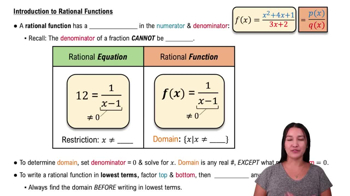
Rational functions are ratios of polynomials, and their behavior near certain points can lead to infinite limits. In the given limit, as x approaches 0, the term 1/x² dominates the expression, leading to an increase towards infinity. Understanding how the numerator and denominator interact as x approaches critical values is essential for analyzing limits effectively.
Video consigliato:
6:04
Intro to Rational Functions