Ch. 2 - Limits
Briggs - Calculus: Early Transcendentals 3rd Edition
Briggs3rd EditionCalculus: Early TranscendentalsISBN: 9780136847243Non è quello che usi tu?Cambia libro di testo
Capitolo 2, Problema 2.33

Determine the following limits.
lim x→0^− 2 / tan x

Guida verificata passo dopo passo
1
Identify the limit expression: \( \lim_{{x \to 0^-}} \frac{2}{\tan x} \).
Recognize that as \( x \to 0^- \), \( \tan x \to 0^- \) because the tangent function approaches zero from the negative side.
Understand that \( \frac{2}{\tan x} \) will approach infinity or negative infinity depending on the sign of \( \tan x \) as \( x \to 0^- \).
Since \( \tan x \to 0^- \), the expression \( \frac{2}{\tan x} \) will approach negative infinity.
Conclude that the limit is \( -\infty \) as \( x \to 0^- \).

Risposta video verificata per un problema simile:

Questa soluzione video è stata consigliata dai nostri tutor come utile per risolvere questo problema.
Durata del video:
1m

Concetti chiave

Ecco i concetti essenziali che devi comprendere per rispondere correttamente alla domanda.

Limits

A limit is a fundamental concept in calculus that describes the behavior of a function as its input approaches a certain value. It helps in understanding how functions behave near points of interest, including points where they may not be defined. In this case, we are interested in the limit of the function as x approaches 0 from the left (denoted as x→0^−).
Video consigliato:
05:50
One-Sided Limits

Tangent Function

The tangent function, tan(x), is a periodic function defined as the ratio of the sine and cosine functions: tan(x) = sin(x)/cos(x). It has specific properties, including vertical asymptotes where cos(x) = 0, which occur at odd multiples of π/2. Understanding the behavior of tan(x) near x = 0 is crucial for evaluating the limit in the question.
Video consigliato:
Percorso guidato
05:13
Slopes of Tangent Lines

One-Sided Limits

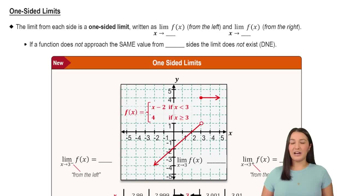
One-sided limits refer to the value that a function approaches as the input approaches a specific point from one side only, either from the left (denoted as x→c^−) or from the right (denoted as x→c^+). In this problem, we are specifically looking at the left-hand limit as x approaches 0, which can yield different results than the right-hand limit, especially for functions with discontinuities.
Video consigliato:
05:50
One-Sided Limits
Pratica correlata
Domanda del libro di testo

Determine the following limits.


limθ→0−sinθcos2θ−1{\(\displaystyle\[\lim\)_{\(\theta\]\to\)0^{-}}\(\frac{\sin\theta}{\cos^2\theta-1}\)}

297
views
Domanda del libro di testo

Determine limx→∞f(x)\(\lim\)_{x\(\rightarrow\)\(\infty\)}f\(\left\)(x\(\right\)) and limx→−∞f(x)\(\lim\)_{x\(\rightarrow\)-\(\infty\)}f\(\left\)(x\(\right\)) for the following functions. Then give the horizontal asymptotes of ff (if any).


f(x)=x6+834x2+3x4+1f\(\left\)(x\(\right\))=\(\frac{\sqrt[3]{x^6+8}\)}{4x^2+\(\sqrt{3x^4+1}\)}

323
views
Domanda del libro di testo

Use the precise definition of infinite limits to prove the following limits.


limx→0(1x2+1)=∞{\(\displaystyle\)\(\lim\)_{x\(\to\)0}}\(\left\)(\(\frac{1}{x^2}\)+1\(\right\))=\(\infty\)

409
views
Domanda del libro di testo

Complete the following steps for each function.


c. State the interval(s) of continuity.


f(x)={2x if x<1

x^2+3x if x≥1; a=1

347
views
Domanda del libro di testo

Determine the end behavior of the following transcendental functions by analyzing appropriate limits. Then provide a simple sketch of the associated graph, showing asymptotes if they exist. 

f(x)=−3e−xf\(\left\)(x\(\right\))=-3e^{-x}

358
views
Domanda del libro di testo

Evaluate limx→∞f(x){\(\displaystyle\[\lim\)_{x\(\to\]\infty\)}{f(x)}} andlimx→−∞f(x){\(\displaystyle\)\(\lim\)_{x\(\to\)-\(\infty\)}{f(x)}}.


f(x)=6ex+203ex+4f\(\left\)(x\(\right\))=\(\frac{6e^{x}\)+20}{3e^{x}+4}

331
views