Ch. 3 - Derivatives
Briggs - Calculus: Early Transcendentals 3rd Edition
Briggs3rd EditionCalculus: Early TranscendentalsISBN: 9780136847243Non è quello che usi tu?Cambia libro di testo
Capitolo 3, Problema 3.8.20b

13-26 Implicit differentiation Carry out the following steps.
b. Find the slope of the curve at the given point.
tan xy = x+y; (0,0)

Guida verificata passo dopo passo
1
Start by differentiating both sides of the equation with respect to x. The equation is \( \tan(xy) = x + y \). Use implicit differentiation, which involves differentiating each term while treating y as a function of x.
Differentiate the left side: The derivative of \( \tan(u) \) with respect to u is \( \sec^2(u) \), so apply the chain rule: \( \frac{d}{dx}[\tan(xy)] = \sec^2(xy) \cdot \frac{d}{dx}(xy) \).
Apply the product rule to differentiate \( xy \): \( \frac{d}{dx}(xy) = x \frac{dy}{dx} + y \). Therefore, the derivative of the left side becomes \( \sec^2(xy) \cdot (x \frac{dy}{dx} + y) \).
Differentiate the right side: The derivative of \( x + y \) with respect to x is \( 1 + \frac{dy}{dx} \).
Set the derivatives equal to each other: \( \sec^2(xy) \cdot (x \frac{dy}{dx} + y) = 1 + \frac{dy}{dx} \). Solve this equation for \( \frac{dy}{dx} \) to find the slope of the curve at the point (0,0). Substitute x = 0 and y = 0 into the equation to find the specific slope at that point.

Risposta video verificata per un problema simile:

Questa soluzione video è stata consigliata dai nostri tutor come utile per risolvere questo problema.
Durata del video:
5m

Concetti chiave

Ecco i concetti essenziali che devi comprendere per rispondere correttamente alla domanda.

Implicit Differentiation

Implicit differentiation is a technique used to differentiate equations where the dependent and independent variables are not explicitly separated. Instead of solving for one variable in terms of the other, we differentiate both sides of the equation with respect to the independent variable, applying the chain rule as necessary. This method is particularly useful for curves defined by equations like 'tan(xy) = x + y', where y cannot be easily isolated.
Video consigliato:
Percorso guidato
05:14
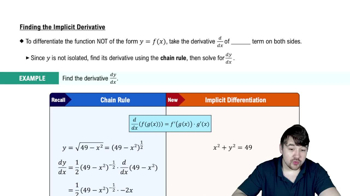
Finding The Implicit Derivative

Slope of a Curve

The slope of a curve at a given point represents the rate of change of the function at that point, which is mathematically expressed as the derivative. For a curve defined implicitly, the slope can be found by evaluating the derivative obtained through implicit differentiation. In this case, we will find the slope at the point (0,0) by substituting these coordinates into the derivative expression.
Video consigliato:
11:41
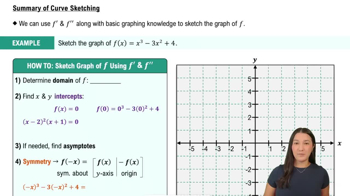
Summary of Curve Sketching

Chain Rule

The chain rule is a fundamental principle in calculus used to differentiate composite functions. It states that if a function y is defined as a function of u, which in turn is a function of x, then the derivative of y with respect to x can be found by multiplying the derivative of y with respect to u by the derivative of u with respect to x. This rule is essential in implicit differentiation, where we often need to differentiate terms involving products of variables.
Video consigliato:
05:02
Intro to the Chain Rule
Pratica correlata
Domanda del libro di testo

Derivatives using tables Let h(x)=f(g(x))h(x)=f(g(x)) and p(x)=g(f(x))p(x)=g(f(x)). Use the table to compute the following derivatives.

<IMAGE>

b. h′(2)h^{\(\prime\)}\(\left\)(2\(\right\))

278
views
Domanda del libro di testo

{Use of Tech} Angle of elevation A small plane, moving at 70 m/s, flies horizontally on a line 400 meters directly above an observer. Let θ be the angle of elevation of the plane (see figure). <IMAGE>


b. Graph dθ/dx as a function of x and determine the point at which θ changes most rapidly.

160
views
Domanda del libro di testo

Explain why or why not Determine whether the following statements are true and give an explanation or counterexample.

b. d/dx(tan^−1 x) =sec² x

149
views
Domanda del libro di testo

Derivatives and tangent lines

b. Determine an equation of the line tangent to the graph of f at the point (a,f(a)) for the given value of a.

f(x) = √3x; a= 12

227
views
Domanda del libro di testo

The energy (in joules) released by an earthquake of magnitude M is given by the equation E=25,000 ⋅ 101.5M. (This equation can be solved for M to define the magnitude of a given earthquake; it is a refinement of the original Richter scale created by Charles Richter in 1935.)

Compute dE/dM and evaluate it for M=3. What does this derivative mean? (M has no units, so the units of the derivative are J per change in magnitude.)

267
views
Domanda del libro di testo

A differential equation is an equation involving an unknown function and its derivatives. Consider the differential equation y′′(t)+y(t) = 0.

b. Show that y = B cos t satisfies the equation for any constant B.

254
views