Ch. 3 - Derivatives
Briggs - Calculus: Early Transcendentals 3rd Edition
Briggs3rd EditionCalculus: Early TranscendentalsISBN: 9780136847243Non è quello che usi tu?Cambia libro di testo
Capitolo 3, Problema 3.10.61b

Explain why or why not Determine whether the following statements are true and give an explanation or counterexample.
b. d/dx(tan^−1 x) =sec² x

Guida verificata passo dopo passo
1
To determine whether the statement \( \frac{d}{dx}(\tan^{-1} x) = \sec^2 x \) is true, we need to find the derivative of \( \tan^{-1} x \).
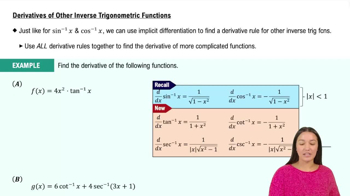
Recall that \( \tan^{-1} x \) is the inverse function of \( \tan x \). The derivative of \( \tan^{-1} x \) is given by the formula \( \frac{d}{dx}(\tan^{-1} x) = \frac{1}{1 + x^2} \).
Compare the derivative \( \frac{1}{1 + x^2} \) with \( \sec^2 x \). Note that \( \sec^2 x = 1 + \tan^2 x \), which is different from \( \frac{1}{1 + x^2} \).
Since \( \frac{1}{1 + x^2} \) is not equal to \( \sec^2 x \), the statement \( \frac{d}{dx}(\tan^{-1} x) = \sec^2 x \) is false.
Therefore, the correct derivative of \( \tan^{-1} x \) is \( \frac{1}{1 + x^2} \), not \( \sec^2 x \). This serves as a counterexample to the given statement.

Risposta video verificata per un problema simile:

Questa soluzione video è stata consigliata dai nostri tutor come utile per risolvere questo problema.
Durata del video:
3m

Concetti chiave

Ecco i concetti essenziali che devi comprendere per rispondere correttamente alla domanda.

Derivative of Inverse Functions

The derivative of an inverse function can be found using the formula (d/dx)(f^−1(x)) = 1/(f'(f^−1(x))). For the function f(x) = tan(x), its inverse is f^−1(x) = tan^−1(x). Understanding this relationship is crucial for differentiating inverse trigonometric functions like tan^−1(x).
Video consigliato:
07:26
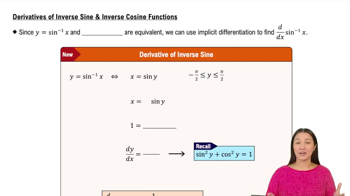
Derivatives of Inverse Sine & Inverse Cosine

Trigonometric Derivatives

Knowing the derivatives of basic trigonometric functions is essential. For example, the derivative of tan(x) is sec²(x). This knowledge helps in finding the derivative of its inverse, tan^−1(x), and is fundamental in verifying the correctness of derivative statements.
Video consigliato:
06:35
Derivatives of Other Inverse Trigonometric Functions

Chain Rule

The chain rule is a fundamental principle in calculus used to differentiate composite functions. It states that if a function y = f(g(x)), then dy/dx = f'(g(x)) * g'(x). This rule is particularly useful when dealing with functions like tan^−1(x) that can be expressed in terms of other functions, aiding in the differentiation process.
Video consigliato:
05:02
Intro to the Chain Rule