Ch. 3 - Derivatives
Briggs - Calculus: Early Transcendentals 3rd Edition
Briggs3rd EditionCalculus: Early TranscendentalsISBN: 9780136847243Non è quello che usi tu?Cambia libro di testo
Capitolo 3, Problema 3.2.25b

21–30. Derivatives
b. Evaluate f'(a) for the given values of a.
f(x) = 1/x+1; a = -1/2;5

Guida verificata passo dopo passo
1
Step 1: Identify the function f(x) = \(\frac{1}{x}\) + 1 and the points a = -\(\frac{1}{2}\) and a = 5 where we need to evaluate the derivative f'(a).
Step 2: Find the derivative of the function f(x). The function can be rewritten as f(x) = x^{-1} + 1. Use the power rule for derivatives, which states that \(\frac{d}{dx}\)[x^n] = nx^{n-1}, to find f'(x).
Step 3: Apply the power rule to f(x) = x^{-1} + 1. The derivative of x^{-1} is -x^{-2}, and the derivative of a constant (1) is 0. Therefore, f'(x) = -x^{-2}.
Step 4: Evaluate f'(x) at a = -\(\frac{1}{2}\). Substitute x = -\(\frac{1}{2}\) into f'(x) = -x^{-2} to find f'(-\(\frac{1}{2}\)).
Step 5: Evaluate f'(x) at a = 5. Substitute x = 5 into f'(x) = -x^{-2} to find f'(5).

Risposta video verificata per un problema simile:

Questa soluzione video è stata consigliata dai nostri tutor come utile per risolvere questo problema.
Durata del video:
7m

Concetti chiave

Ecco i concetti essenziali che devi comprendere per rispondere correttamente alla domanda.

Derivatives

A derivative represents the rate of change of a function with respect to its variable. It is a fundamental concept in calculus that provides information about the slope of the tangent line to the curve of the function at a given point. The derivative can be computed using various rules, such as the power rule, product rule, and quotient rule, depending on the form of the function.
Video consigliato:

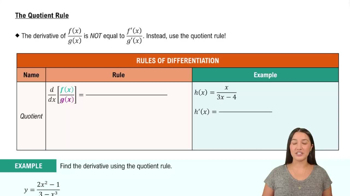
Quotient Rule

The quotient rule is a method for finding the derivative of a function that is the ratio of two other functions. If f(x) = g(x)/h(x), the derivative f'(x) is given by f'(x) = (g'(x)h(x) - g(x)h'(x)) / (h(x))^2. This rule is essential when dealing with functions that involve division, such as the function f(x) = 1/(x+1) in the given question.
Video consigliato:
06:43
The Quotient Rule

Evaluating Derivatives at Specific Points

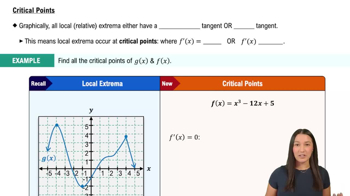
Evaluating the derivative at a specific point involves substituting the value of that point into the derivative function. This process provides the slope of the tangent line to the function at that particular point, which can be useful for understanding the behavior of the function. In this case, we need to compute f'(-1/2) and f'(5) to analyze the function's behavior at these values.
Video consigliato:
04:50
Critical Points
Pratica correlata
Domanda del libro di testo

Vertical tangent lines

b. Does the curve have any horizontal tangent lines? Explain.

313
views

Domanda del libro di testo

45–50. Tangent lines Carry out the following steps. <IMAGE>

b. Determine an equation of the line tangent to the curve at the given point.

x³+y³=2xy; (1, 1)

269
views
Domanda del libro di testo

Explain why or why not. Determine whether the following statements are true and give an explanation or counterexample.


b. ln(x + 1) + ln(x − 1) = ln(x² − 1), for all x.

155
views
Domanda del libro di testo

Explain why or why not Determine whether the following statements are true and give an explanation or counter example.

b. d²/dx² (sin x) = sin x.

176
views
Domanda del libro di testo

{Use of Tech} Spring oscillations A spring hangs from the ceiling at equilibrium with a mass attached to its end. Suppose you pull downward on the mass and release it 10 inches below its equilibrium position with an upward push. The distance x (in inches) of the mass from its equilibrium position after t seconds is given by the function x(t) = 10sin t - 10cos t, where x is positive when the mass is above the equilibrium position. <IMAGE>

b. Find dx/dt and interpret the meaning of this derivative.  

208
views
Domanda del libro di testo

109-112 {Use of Tech} Calculating limits The following limits are the derivatives of a composite function g at a point a.

b. Use the Chain Rule to find each limit. Verify your answer by using a calculator.

limx→04+sin(x)−2x{\(\displaystyle\)\(\lim\)_{x\(\to\)0}}\(\frac{\sqrt{4+\sin\left(x\right)}\)-2}{x}

263
views