Ch. 3 - Derivatives
Briggs - Calculus: Early Transcendentals 3rd Edition
Briggs3rd EditionCalculus: Early TranscendentalsISBN: 9780136847243Non è quello che usi tu?Cambia libro di testo
Capitolo 3, Problema 3.8.28

27–40. Implicit differentiation Use implicit differentiation to find dy/dx.
y = xe^y

Guida verificata passo dopo passo
1
Start by differentiating both sides of the equation with respect to x. The equation is y = x * e^y.
Apply the product rule to the right side of the equation. The product rule states that d(uv)/dx = u'v + uv', where u = x and v = e^y.
Differentiate u = x with respect to x, which gives 1. Differentiate v = e^y with respect to x, which requires the chain rule: d(e^y)/dx = e^y * dy/dx.
Substitute the derivatives back into the product rule: d(x * e^y)/dx = 1 * e^y + x * e^y * dy/dx.
Set the derivative of the left side, dy/dx, equal to the derivative of the right side: dy/dx = e^y + x * e^y * dy/dx. Solve for dy/dx by isolating it on one side of the equation.

Risposta video verificata per un problema simile:

Questa soluzione video è stata consigliata dai nostri tutor come utile per risolvere questo problema.
Durata del video:
6m

Concetti chiave

Ecco i concetti essenziali che devi comprendere per rispondere correttamente alla domanda.

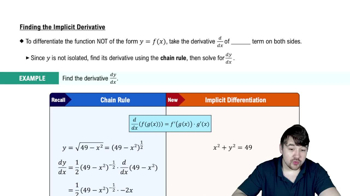
Implicit Differentiation

Implicit differentiation is a technique used to differentiate equations where the dependent and independent variables are not explicitly separated. Instead of solving for one variable in terms of the other, we differentiate both sides of the equation with respect to the independent variable, applying the chain rule as necessary. This method is particularly useful for equations that are difficult or impossible to rearrange.
Video consigliato:
Percorso guidato
05:14
Finding The Implicit Derivative

Chain Rule

The chain rule is a fundamental principle in calculus that allows us to differentiate composite functions. It states that if a function y is defined as a function of u, which is in turn a function of x, then the derivative of y with respect to x can be found by multiplying the derivative of y with respect to u by the derivative of u with respect to x. This is essential in implicit differentiation when dealing with functions of y.
Video consigliato:
05:02
Intro to the Chain Rule

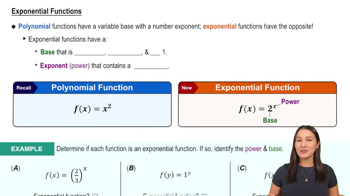
Exponential Functions

Exponential functions are mathematical functions of the form f(x) = a * e^(bx), where e is the base of natural logarithms, and a and b are constants. In the context of implicit differentiation, recognizing the properties of exponential functions, such as their derivatives, is crucial. The derivative of e^(y) with respect to x involves both the chain rule and the derivative of y, making it important to apply these concepts correctly.
Video consigliato:
6:13
Exponential Functions