Ch. 3 - Derivatives
Briggs - Calculus: Early Transcendentals 3rd Edition
Briggs3rd EditionCalculus: Early TranscendentalsISBN: 9780136847243Non è quello che usi tu?Cambia libro di testo
Capitolo 3, Problema 3.9.55

49–55. Derivatives of tower functions (or g^h) Find the derivative of each function and evaluate the derivative at the given value of a.
f (x) = (4 sin x+2)^cos x; a = π

Guida verificata passo dopo passo
1
First, recognize that the function f(x) = (4 sin x + 2)^cos x is a tower function, which can be expressed in the form g(x)^h(x). To differentiate this type of function, use the logarithmic differentiation method.
Take the natural logarithm of both sides: ln(f(x)) = ln((4 sin x + 2)^cos x). This simplifies to ln(f(x)) = cos x * ln(4 sin x + 2) using the property of logarithms ln(a^b) = b * ln(a).
Differentiate both sides with respect to x. For the left side, use the chain rule: d/dx[ln(f(x))] = (1/f(x)) * f'(x). For the right side, apply the product rule: d/dx[cos x * ln(4 sin x + 2)] = -sin x * ln(4 sin x + 2) + cos x * (1/(4 sin x + 2)) * (4 cos x).
Solve for f'(x) by multiplying both sides by f(x): f'(x) = f(x) * [-sin x * ln(4 sin x + 2) + cos x * (4 cos x)/(4 sin x + 2)].
Finally, evaluate f'(x) at x = π. Substitute x = π into the expression for f'(x) and simplify. Remember that sin(π) = 0 and cos(π) = -1, which will help simplify the calculations.

Risposta video verificata per un problema simile:

Questa soluzione video è stata consigliata dai nostri tutor come utile per risolvere questo problema.
Durata del video:
15m

Concetti chiave

Ecco i concetti essenziali che devi comprendere per rispondere correttamente alla domanda.

Chain Rule

The Chain Rule is a fundamental differentiation technique used to find the derivative of composite functions. It states that if a function y is composed of another function u, then the derivative of y with respect to x can be found by multiplying the derivative of y with respect to u by the derivative of u with respect to x. This rule is essential for differentiating functions like f(x) = (4 sin x + 2)^(cos x), where both the base and the exponent are functions of x.
Video consigliato:
05:02
Intro to the Chain Rule

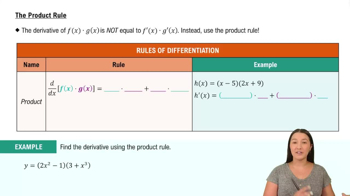
Product Rule

The Product Rule is used to differentiate products of two functions. If u(x) and v(x) are two differentiable functions, the derivative of their product is given by u'v + uv'. This rule is particularly relevant in the context of the given function, as it involves differentiating the base and the exponent, both of which are products of functions themselves.
Video consigliato:
05:18
The Product Rule

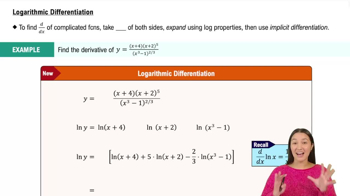
Exponential Functions and Logarithmic Differentiation

Exponential functions, particularly those in the form of g^h, where both g and h are functions of x, can be differentiated using logarithmic differentiation. This technique involves taking the natural logarithm of both sides, simplifying the expression, and then differentiating. This method is useful for the function f(x) = (4 sin x + 2)^(cos x) because it allows for easier manipulation of the exponent and base during differentiation.
Video consigliato:
06:30
Logarithmic Differentiation