A spherical snowball melts at a rate proportional to its surface area. Show that the rate of change of the radius is constant. (Hint: Surface area=4πr².)
Ch. 3 - Derivatives
Briggs3rd EditionCalculus: Early TranscendentalsISBN: 9780136847243Non è quello che usi tu?Cambia libro di testo
Capitolo 3, Problema 3.10.54
47–56. Derivatives of inverse functions at a point Consider the following functions. In each case, without finding the inverse, evaluate the derivative of the inverse at the given point.
f(x)=4e^10x; (4,0)
Guida verificata passo dopo passo1
Step 1: Understand the problem. We need to find the derivative of the inverse function of f(x) = 4e^{10x} at the point (4, 0). This means we need to find (f^{-1})'(0).
Step 2: Use the formula for the derivative of an inverse function. If y = f(x) and f is invertible, then the derivative of the inverse function at a point is given by (f^{-1})'(y) = 1 / f'(x), where f(x) = y.
Step 3: Identify the point of interest. We are given the point (4, 0), which means f(x) = 4 when x = 0. Therefore, we need to find f'(0).
Step 4: Differentiate the function f(x) = 4e^{10x}. The derivative f'(x) is found using the chain rule: f'(x) = 4 * 10 * e^{10x} = 40e^{10x}.
Step 5: Evaluate the derivative at x = 0. Substitute x = 0 into f'(x) to find f'(0) = 40e^{0} = 40. Now, use the inverse derivative formula: (f^{-1})'(0) = 1 / f'(0) = 1 / 40.

Risposta video verificata per un problema simile:
Questa soluzione video è stata consigliata dai nostri tutor come utile per risolvere questo problema.
Durata del video:
4mConcetti chiave
Ecco i concetti essenziali che devi comprendere per rispondere correttamente alla domanda.
Inverse Functions
Inverse functions are functions that 'reverse' the effect of the original function. If f(x) takes an input x and produces an output y, then the inverse function f⁻¹(y) takes y back to x. Understanding how to find and work with inverse functions is crucial for evaluating derivatives of inverses.
Video consigliato:
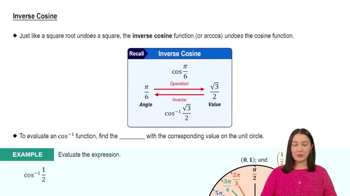
Inverse Cosine
Derivative of Inverse Functions
The derivative of an inverse function can be calculated using the formula (f⁻¹)'(y) = 1 / f'(x), where y = f(x). This relationship shows how the rate of change of the inverse function at a point is related to the rate of change of the original function at the corresponding point. This concept is essential for solving problems involving derivatives of inverse functions.
Video consigliato:
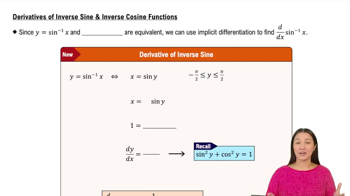
Derivatives of Inverse Sine & Inverse Cosine
Exponential Functions and Their Derivatives
Exponential functions, such as f(x) = 4e^(10x), have specific properties and derivatives. The derivative of an exponential function is proportional to the function itself, specifically f'(x) = k * e^(kx) for some constant k. Understanding how to differentiate exponential functions is necessary for applying the derivative of the inverse function formula.
Video consigliato:
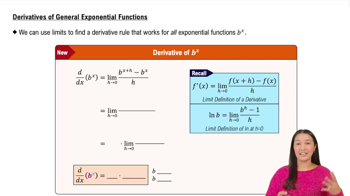
Derivatives of General Exponential Functions
Pratica correlata
Domanda del libro di testo
384
views
Domanda del libro di testo
Find the derivative of the following functions.
y = cos x/sin x + 1
355
views
Domanda del libro di testo
A surface ship is moving (horizontally) in a straight line at 10 km/hr. At the same time, an enemy submarine maintains a position directly below the ship while diving at an angle that is 20° below the horizontal. How fast is the submarine’s altitude decreasing?
292
views
Domanda del libro di testo
15–48. Derivatives Find the derivative of the following functions.
y = In (x³+1)^π
366
views
Domanda del libro di testo
Find the derivative of the following functions.
y = x sin x
331
views
Domanda del libro di testo
23–51. Calculating derivatives Find the derivative of the following functions.
y = a sin x + b cos x/a sin x - b cos x; a and b are nonzero constants
309
views