Ch. 3 - Derivatives
Briggs - Calculus: Early Transcendentals 3rd Edition
Briggs3rd EditionCalculus: Early TranscendentalsISBN: 9780136847243Non è quello che usi tu?Cambia libro di testo
Capitolo 3, Problema 3.11.49

A surface ship is moving (horizontally) in a straight line at 10 km/hr. At the same time, an enemy submarine maintains a position directly below the ship while diving at an angle that is 20° below the horizontal. How fast is the submarine’s altitude decreasing?

Guida verificata passo dopo passo
1
First, identify the components of the submarine's velocity. The submarine is diving at an angle of 20° below the horizontal, which means its velocity can be split into horizontal and vertical components.
The horizontal component of the submarine's velocity is the same as the ship's velocity, which is 10 km/hr. This is because the submarine maintains a position directly below the ship.
To find the vertical component of the submarine's velocity, use trigonometry. The vertical component can be found using the sine function: \( v_{vertical} = v_{total} \cdot \sin(20°) \).
Since the horizontal component is 10 km/hr, use the cosine function to find the total velocity of the submarine: \( v_{total} = \frac{10}{\cos(20°)} \).
Substitute the total velocity into the equation for the vertical component: \( v_{vertical} = \frac{10}{\cos(20°)} \cdot \sin(20°) \). This will give you the rate at which the submarine's altitude is decreasing.

Risposta video verificata per un problema simile:

Questa soluzione video è stata consigliata dai nostri tutor come utile per risolvere questo problema.
Durata del video:
5m

Concetti chiave

Ecco i concetti essenziali che devi comprendere per rispondere correttamente alla domanda.

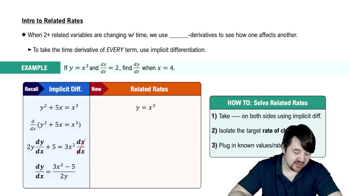
Related Rates

Related rates involve finding the rate at which one quantity changes in relation to another. In this problem, we need to relate the horizontal speed of the ship to the vertical speed of the submarine as it dives. By using derivatives, we can establish a relationship between the rates of change of the ship's position and the submarine's altitude.
Video consigliato:
Percorso guidato
04:16
Intro To Related Rates

Trigonometric Functions

Trigonometric functions, particularly sine and cosine, are essential for analyzing angles and distances in this scenario. The angle of 20° below the horizontal allows us to use these functions to determine the vertical component of the submarine's movement. Understanding how to decompose the submarine's velocity into horizontal and vertical components is crucial for solving the problem.
Video consigliato:
Percorso guidato
6:04
Introduction to Trigonometric Functions

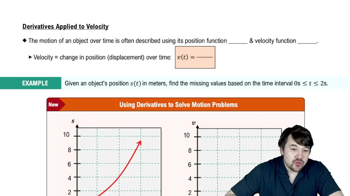
Velocity Components

Velocity components refer to breaking down a velocity vector into its horizontal and vertical parts. In this case, the submarine's velocity can be split into a horizontal component (which matches the ship's speed) and a vertical component (which represents the rate of altitude decrease). This decomposition is vital for applying the related rates concept effectively.
Video consigliato:
Percorso guidato
06:29
Derivatives Applied To Velocity