Ch. 3 - Derivatives
Briggs - Calculus: Early Transcendentals 3rd Edition
Briggs3rd EditionCalculus: Early TranscendentalsISBN: 9780136847243Non è quello che usi tu?Cambia libro di testo
Capitolo 3, Problema 3.9.80

75–86. Logarithmic differentiation Use logarithmic differentiation to evaluate f'(x).
f(x) = tan¹⁰x / (5x+3)⁶

Guida verificata passo dopo passo
1
Step 1: Begin by taking the natural logarithm of both sides of the equation y = (tan^10(x)) / (5x + 3)^6. This gives ln(y) = ln((tan^10(x)) / (5x + 3)^6).
Step 2: Use the properties of logarithms to simplify the expression. The logarithm of a quotient is the difference of the logarithms: ln(y) = ln(tan^10(x)) - ln((5x + 3)^6).
Step 3: Apply the power rule for logarithms, which states that ln(a^b) = b*ln(a). This gives ln(y) = 10*ln(tan(x)) - 6*ln(5x + 3).
Step 4: Differentiate both sides with respect to x. The left side becomes (1/y) * dy/dx by implicit differentiation. The right side requires the chain rule: 10 * (1/tan(x)) * sec^2(x) - 6 * (1/(5x + 3)) * 5.
Step 5: Solve for dy/dx by multiplying both sides by y. Substitute back y = (tan^10(x)) / (5x + 3)^6 to express dy/dx in terms of x. This gives dy/dx = y * [10 * (1/tan(x)) * sec^2(x) - 6 * (1/(5x + 3)) * 5].

Risposta video verificata per un problema simile:

Questa soluzione video è stata consigliata dai nostri tutor come utile per risolvere questo problema.
Durata del video:
6m

Concetti chiave

Ecco i concetti essenziali che devi comprendere per rispondere correttamente alla domanda.

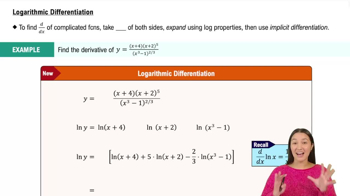
Logarithmic Differentiation

Logarithmic differentiation is a technique used to differentiate functions that are products or quotients of other functions, especially when they involve powers. By taking the natural logarithm of both sides of the function, we can simplify the differentiation process, allowing us to use properties of logarithms to break down complex expressions into manageable parts.
Video consigliato:
06:30
Logarithmic Differentiation

Chain Rule

The chain rule is a fundamental principle in calculus used to differentiate composite functions. It states that if a function y is composed of another function u, then the derivative of y with respect to x can be found by multiplying the derivative of y with respect to u by the derivative of u with respect to x. This is essential when dealing with functions raised to powers or nested functions.
Video consigliato:
05:02
Intro to the Chain Rule

Product and Quotient Rules

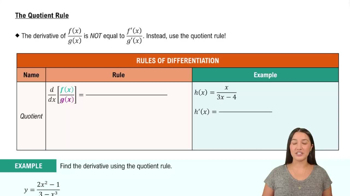
The product and quotient rules are essential for differentiating functions that are products or ratios of two or more functions. The product rule states that the derivative of a product of two functions is the first function times the derivative of the second plus the second function times the derivative of the first. The quotient rule, on the other hand, provides a method for differentiating a ratio of two functions, ensuring accurate results when applying these rules in logarithmic differentiation.
Video consigliato:
06:43
The Quotient Rule