Ch. 3 - Derivatives
Briggs - Calculus: Early Transcendentals 3rd Edition
Briggs3rd EditionCalculus: Early TranscendentalsISBN: 9780136847243Non è quello che usi tu?Cambia libro di testo
Capitolo 3, Problema 3.9.62

The graph of y =xln x has one horizontal tangent line. Find an equation for it.

Guida verificata passo dopo passo
1
Step 1: Recognize that a horizontal tangent line occurs where the derivative of the function is zero. Therefore, we need to find the derivative of the function y = x^{\(\ln\) x}.
Step 2: To differentiate y = x^{\(\ln\) x}, use logarithmic differentiation. Start by taking the natural logarithm of both sides: \(\ln\) y = \(\ln\)(x^{\(\ln\) x}) = \(\ln\) x \(\cdot\) \(\ln\) x.
Step 3: Differentiate both sides with respect to x. The left side becomes \(\frac{1}{y}\) \(\cdot\) \(\frac{dy}{dx}\) using the chain rule, and the right side becomes \(\frac{d}{dx}\)(\(\ln\) x \(\cdot\) \(\ln\) x) using the product rule.
Step 4: Apply the product rule to differentiate \(\ln\) x \(\cdot\) \(\ln\) x: \(\frac{d}{dx}\)(\(\ln\) x \(\cdot\) \(\ln\) x) = \(\ln\) x \(\cdot\) \(\frac{1}{x}\) + \(\ln\) x \(\cdot\) \(\frac{1}{x}\) = 2 \(\cdot\) \(\frac{(\ln x)}{x}\).
Step 5: Substitute back to find \(\frac{dy}{dx}\): \(\frac{1}{y}\) \(\cdot\) \(\frac{dy}{dx}\) = 2 \(\cdot\) \(\frac{(\ln x)}{x}\). Solve for \(\frac{dy}{dx}\) and set it to zero to find the x-value where the tangent is horizontal.

Risposta video verificata per un problema simile:

Questa soluzione video è stata consigliata dai nostri tutor come utile per risolvere questo problema.
Durata del video:
4m

Concetti chiave

Ecco i concetti essenziali che devi comprendere per rispondere correttamente alla domanda.

Derivative

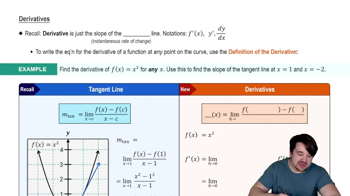
The derivative of a function measures the rate at which the function's value changes as its input changes. It is a fundamental concept in calculus used to find slopes of tangent lines. For a function to have a horizontal tangent line, its derivative must equal zero at that point.
Video consigliato:

Critical Points

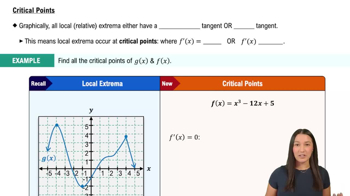
Critical points occur where the derivative of a function is either zero or undefined. These points are essential for identifying local maxima, minima, and points of inflection. In the context of the given function, finding critical points will help determine where the horizontal tangent line exists.
Video consigliato:
04:50
Critical Points

Exponential and Logarithmic Functions

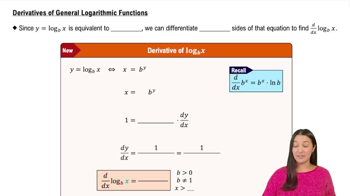
The function y = x ln x involves both polynomial and logarithmic components. Understanding the properties of logarithmic functions, such as their growth rates and behavior, is crucial for analyzing the function's graph and finding its derivative. This knowledge aids in solving for the horizontal tangent line effectively.
Video consigliato:
06:32
Derivatives of General Logarithmic Functions