
Ch. 3 - Derivatives
Briggs - Calculus: Early Transcendentals 3rd Edition
Briggs3rd EditionCalculus: Early TranscendentalsISBN: 9780136847243Non è quello che usi tu?Cambia libro di testo
Capitolo 3, Problema 3.5.55b

An object oscillates along a vertical line, and its position in centimeters is given by y(t) = 30(sint - 1), where t ≥ 0 is measured in seconds and y is positive in the upward direction.
Find the velocity of the oscillator, v(t) =y′(t).

Guida verificata passo dopo passo
1
To find the velocity of the oscillator, we need to differentiate the position function y(t) = 30(sin(t) - 1) with respect to time t.
Recall that the derivative of sin(t) with respect to t is cos(t). Therefore, apply the derivative to each term in the function y(t).
The derivative of the constant term -30 is 0, since constants do not change with respect to t.
Differentiate the term 30sin(t) using the chain rule. The derivative of 30sin(t) is 30cos(t).
Combine the derivatives to get the velocity function v(t) = y'(t) = 30cos(t).

Risposta video verificata per un problema simile:

Questa soluzione video è stata consigliata dai nostri tutor come utile per risolvere questo problema.
Durata del video:
2m

Concetti chiave

Ecco i concetti essenziali che devi comprendere per rispondere correttamente alla domanda.

Differentiation

Differentiation is a fundamental concept in calculus that involves finding the derivative of a function. The derivative represents the rate of change of the function with respect to its variable. In this context, differentiating the position function y(t) = 30(sin(t) - 1) will yield the velocity function v(t), which describes how the position of the object changes over time.
Video consigliato:
Percorso guidato
05:53
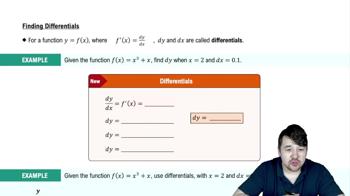
Finding Differentials

Trigonometric Functions

Trigonometric functions, such as sine and cosine, are essential in modeling periodic phenomena, including oscillations. The sine function, in particular, describes the oscillatory behavior of the object in this problem. Understanding the properties of these functions, including their ranges and periodicity, is crucial for analyzing the motion of the oscillator.
Video consigliato:
Percorso guidato
6:04
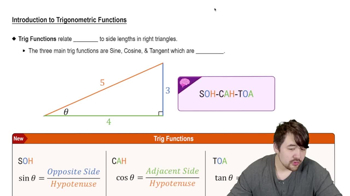
Introduction to Trigonometric Functions

Velocity

Velocity is a vector quantity that indicates the rate of change of an object's position with respect to time. In this scenario, the velocity function v(t) is derived from the position function y(t) by differentiation. It provides insight into how fast and in which direction the object is moving along the vertical line, which is vital for understanding its oscillatory motion.
Video consigliato:
Percorso guidato
06:29
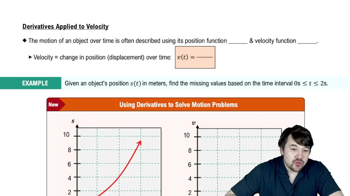
Derivatives Applied To Velocity
Pratica correlata
Domanda del libro di testo

Owlet talons Let L (t) equal the average length (in mm) of the middle talon on an Indian spotted owlet that is t weeks old, as shown in the figure.<IMAGE>

b. Estimate the value of L'(a) for a ≥ 4 . What does this tell you about the talon lengths on these birds? (Source: ZooKeys, 132, 2011)

178
views
Domanda del libro di testo

13-26 Implicit differentiation Carry out the following steps.

b. Find the slope of the curve at the given point.

cos y = x; (0, π/2)

192
views
Domanda del libro di testo

For what values of x does g(x) = x−sin x have a slope of 1?

247
views
Domanda del libro di testo

{Use of Tech} Power and energy The total energy in megawatt-hr (MWh) used by a town is given by E(t) = 400t+2400/π sin πt/12, where t≥0 is measured in hours, with t=0 corresponding to noon.

b. At what time of day is the rate of energy consumption a maximum? What is the power at that time of day?

283
views
Domanda del libro di testo

13-26 Implicit differentiation Carry out the following steps.

b. Find the slope of the curve at the given point.

sin y = 5x⁴−5; (1, π)

208
views
Domanda del libro di testo

{Use of Tech} Fuel economy Suppose you own a fuel-efficient hybrid automobile with a monitor on the dashboard that displays the mileage and gas consumption. The number of miles you can drive with g gallons of gas remaining in the tank on a particular stretch of highway is given by m(g) = 50g−25.8g²+12.5g³−1.6g⁴, for 0≤g≤4.

b. Graph and interpret the gas mileage m(g)/g. 

241
views