


Ch. 3 - Derivatives
Briggs - Calculus: Early Transcendentals 3rd Edition
Briggs3rd EditionCalculus: Early TranscendentalsISBN: 9780136847243Non è quello che usi tu?Cambia libro di testo
Capitolo 3, Problema 3.5.76b

For what values of x does g(x) = x−sin x have a slope of 1?

Guida verificata passo dopo passo
1
First, understand that the slope of a function at a given point is represented by its derivative. So, we need to find the derivative of g(x) = x - sin(x).
Calculate the derivative of g(x). The derivative of x is 1, and the derivative of sin(x) is cos(x). Therefore, the derivative g'(x) = 1 - cos(x).
Set the derivative equal to the desired slope, which is 1. This gives us the equation: 1 - cos(x) = 1.
Solve the equation 1 - cos(x) = 1 for x. Simplifying, we find that cos(x) must be equal to 0.
Determine the values of x for which cos(x) = 0. These values occur at x = (2n+1)π/2, where n is an integer.

Risposta video verificata per un problema simile:

Questa soluzione video è stata consigliata dai nostri tutor come utile per risolvere questo problema.
Durata del video:
3m

Concetti chiave

Ecco i concetti essenziali che devi comprendere per rispondere correttamente alla domanda.

Derivative

The derivative of a function measures the rate at which the function's value changes as its input changes. It is often interpreted as the slope of the tangent line to the graph of the function at a given point. In this context, finding where the slope of g(x) equals 1 involves calculating the derivative g'(x) and setting it equal to 1.
Video consigliato:

Trigonometric Functions

Trigonometric functions, such as sine and cosine, are fundamental in calculus, especially when dealing with periodic phenomena. The function sin(x) oscillates between -1 and 1, and its behavior influences the overall shape and slope of the function g(x) = x - sin(x). Understanding how these functions behave is crucial for analyzing the derivative.
Video consigliato:
Percorso guidato
6:04
Introduction to Trigonometric Functions

Critical Points

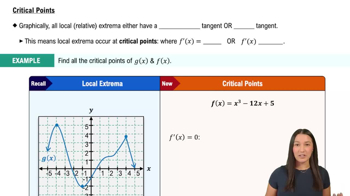
Critical points occur where the derivative of a function is zero or undefined. These points are essential for determining where the function's slope changes, which can indicate local maxima, minima, or points of inflection. In this problem, identifying critical points of g'(x) will help locate the values of x where the slope is equal to 1.
Video consigliato:
04:50
Critical Points
Pratica correlata
Domanda del libro di testo

An object oscillates along a vertical line, and its position in centimeters is given by y(t) = 30(sint - 1), where t ≥ 0 is measured in seconds and y is positive in the upward direction.

Find the velocity of the oscillator, v(t) =y′(t).

274
views
Domanda del libro di testo

13-26 Implicit differentiation Carry out the following steps.

b. Find the slope of the curve at the given point.

cos y = x; (0, π/2)

192
views
Domanda del libro di testo

The Chain Rule for second derivatives

b. Use the formula in part (a) to calculate d2dx2(sin(3x4+5x2+2))\(\frac{d^2}{dx^2}\[\left\)(\(\sin\]\left\)(3x^4+5x^2+2\(\right\))\(\right\)).

408
views
Domanda del libro di testo

{Use of Tech} Power and energy The total energy in megawatt-hr (MWh) used by a town is given by E(t) = 400t+2400/π sin πt/12, where t≥0 is measured in hours, with t=0 corresponding to noon.

b. At what time of day is the rate of energy consumption a maximum? What is the power at that time of day?

283
views
Domanda del libro di testo

{Use of Tech} Spring oscillations A spring hangs from the ceiling at equilibrium with a mass attached to its end. Suppose you pull downward on the mass and release it 10 inches below its equilibrium position with an upward push. The distance x (in inches) of the mass from its equilibrium position after t seconds is given by the function x(t) = 10sin t - 10cos t, where x is positive when the mass is above the equilibrium position. <IMAGE>

b. Find dx/dt and interpret the meaning of this derivative.  

208
views
Domanda del libro di testo

109-112 {Use of Tech} Calculating limits The following limits are the derivatives of a composite function g at a point a.

b. Use the Chain Rule to find each limit. Verify your answer by using a calculator.

limx→04+sin(x)−2x{\(\displaystyle\)\(\lim\)_{x\(\to\)0}}\(\frac{\sqrt{4+\sin\left(x\right)}\)-2}{x}

263
views