Ch. 3 - Derivatives
Briggs - Calculus: Early Transcendentals 3rd Edition
Briggs3rd EditionCalculus: Early TranscendentalsISBN: 9780136847243Non è quello che usi tu?Cambia libro di testo
Capitolo 3, Problema 3.9.63

Calculate the derivative of the following functions. In some cases, it is useful to use the properties of logarithms to simplify the functions before computing f'(x).


y = 4 log₃(x²−1)

Guida verificata passo dopo passo
1
First, recognize that the function y = 4 log₃(x²−1) can be simplified using the change of base formula for logarithms. The change of base formula is logₐ(b) = ln(b) / ln(a). Therefore, rewrite the function as y = 4 * (ln(x²−1) / ln(3)).
Next, apply the constant multiple rule of differentiation. The derivative of a constant times a function is the constant times the derivative of the function. So, differentiate y = 4 * (ln(x²−1) / ln(3)) with respect to x.
Now, focus on differentiating the natural logarithm part, ln(x²−1). Use the chain rule, which states that the derivative of ln(u) is (1/u) * (du/dx). Here, u = x²−1, so find the derivative of u with respect to x, which is du/dx = 2x.
Substitute the derivative of u back into the chain rule formula. The derivative of ln(x²−1) is (1/(x²−1)) * 2x.
Finally, combine all the parts. The derivative of y = 4 * (ln(x²−1) / ln(3)) is (4/ln(3)) * (2x/(x²−1)). Simplify the expression if necessary.

Risposta video verificata per un problema simile:

Questa soluzione video è stata consigliata dai nostri tutor come utile per risolvere questo problema.
Durata del video:
5m

Concetti chiave

Ecco i concetti essenziali che devi comprendere per rispondere correttamente alla domanda.

Derivative

The derivative of a function measures how the function's output value changes as its input value changes. It is a fundamental concept in calculus, representing the slope of the tangent line to the curve at any given point. The derivative is denoted as f'(x) or dy/dx and can be calculated using various rules, such as the power rule, product rule, and chain rule.
Video consigliato:

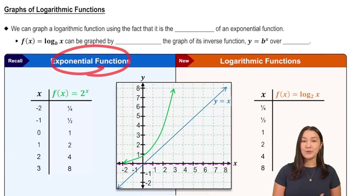
Logarithmic Functions

Logarithmic functions are the inverses of exponential functions and are used to simplify complex expressions, especially when dealing with products or powers. The properties of logarithms, such as the product, quotient, and power rules, allow us to rewrite logarithmic expressions in a more manageable form. For example, logₐ(bc) = logₐ(b) + logₐ(c) helps in breaking down the function before differentiation.
Video consigliato:
5:26
Graphs of Logarithmic Functions

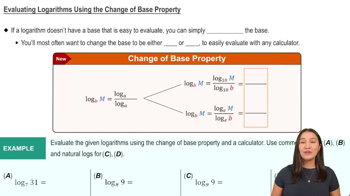
Change of Base Formula

The change of base formula allows us to convert logarithms from one base to another, which can be particularly useful in calculus. For instance, logₐ(b) can be expressed as logₓ(b) / logₓ(a) for any positive x. This is helpful when differentiating logarithmic functions with bases other than e or 10, as it enables the use of natural logarithms, which have simpler derivatives.
Video consigliato:
05:36
Change of Base Property