

Ch. 3 - Derivatives
Briggs - Calculus: Early Transcendentals 3rd Edition
Briggs3rd EditionCalculus: Early TranscendentalsISBN: 9780136847243Non è quello che usi tu?Cambia libro di testo
Capitolo 3, Problema 3.1.59

Find the function The following limits represent the slope of a curve y = f(x) at the point (a,f(a)). Determine a possible function f and number a; then calculate the limit.
(lim h🠂0) (2+h)⁴-16 / h

Guida verificata passo dopo passo
1
Step 1: Recognize that the given limit expression represents the derivative of a function at a point. The expression \( \lim_{h \to 0} \frac{(2+h)^4 - 16}{h} \) is in the form of the difference quotient \( \frac{f(a+h) - f(a)}{h} \), which is used to find the derivative of a function \( f(x) \) at \( x = a \).
Step 2: Identify the function \( f(x) \) and the point \( a \). Notice that \( (2+h)^4 \) suggests that \( f(x) = x^4 \) and \( a = 2 \) because \( f(2) = 2^4 = 16 \).
Step 3: Confirm that the expression matches the derivative form. Substitute \( f(x) = x^4 \) and \( a = 2 \) into the difference quotient: \( \frac{(2+h)^4 - 2^4}{h} \). This matches the given limit expression.
Step 4: Expand \( (2+h)^4 \) using the binomial theorem or direct expansion: \( (2+h)^4 = 16 + 32h + 24h^2 + 8h^3 + h^4 \).
Step 5: Substitute the expanded form back into the limit expression: \( \lim_{h \to 0} \frac{32h + 24h^2 + 8h^3 + h^4}{h} \). Simplify by canceling \( h \) from the numerator and denominator, then evaluate the limit as \( h \to 0 \).

Risposta video verificata per un problema simile:

Questa soluzione video è stata consigliata dai nostri tutor come utile per risolvere questo problema.
Durata del video:
6m

Concetti chiave

Ecco i concetti essenziali che devi comprendere per rispondere correttamente alla domanda.

Limits

Limits are fundamental in calculus, representing the value that a function approaches as the input approaches a certain point. In this context, the limit is used to find the slope of the curve at a specific point, which is essential for understanding the behavior of the function near that point.
Video consigliato:
05:50
One-Sided Limits

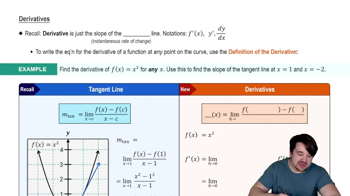
Derivative

The derivative of a function at a point quantifies the rate of change of the function with respect to its variable. It is defined as the limit of the average rate of change as the interval approaches zero. In this problem, calculating the limit will yield the derivative of the function at the point (a, f(a)).
Video consigliato:

Function Evaluation

Function evaluation involves substituting a specific value into a function to determine its output. In this case, identifying a function f and a number a is crucial for calculating the limit and finding the slope of the curve at the point of interest, which is a key step in solving the problem.
Video consigliato:
Percorso guidato
4:26
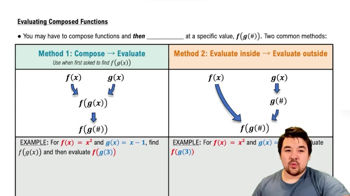
Evaluating Composed Functions