Ch. 3 - Derivatives
Briggs - Calculus: Early Transcendentals 3rd Edition
Briggs3rd EditionCalculus: Early TranscendentalsISBN: 9780136847243Non è quello che usi tu?Cambia libro di testo
Capitolo 3, Problema 56

Calculate the derivative of the following functions.
y = cos7/4(4x3)

Guida verificata passo dopo passo
1
Step 1: Recognize that the function y = \(\cos\)^{7/4}(4x^3) is a composition of functions, which requires the use of the chain rule for differentiation.
Step 2: Let u = 4x^3. Then, the function becomes y = (\(\cos\)(u))^{7/4}. Differentiate y with respect to u using the power rule: \(\frac{dy}{du}\) = \(\frac{7}{4}\)(\(\cos\)(u))^{3/4}(-\(\sin\)(u)).
Step 3: Differentiate u = 4x^3 with respect to x: \(\frac{du}{dx}\) = 12x^2.
Step 4: Apply the chain rule: \(\frac{dy}{dx}\) = \(\frac{dy}{du}\) \(\cdot\) \(\frac{du}{dx}\). Substitute the expressions from Steps 2 and 3 into this formula.
Step 5: Simplify the expression obtained in Step 4 to get the derivative of the original function y with respect to x.

Risposta video verificata per un problema simile:

Questa soluzione video è stata consigliata dai nostri tutor come utile per risolvere questo problema.
Durata del video:
4m

Concetti chiave

Ecco i concetti essenziali che devi comprendere per rispondere correttamente alla domanda.

Derivative

The derivative of a function measures how the function's output value changes as its input value changes. It is a fundamental concept in calculus that provides the slope of the tangent line to the curve at any given point. The derivative is often denoted as f'(x) or dy/dx and can be calculated using various rules, such as the power rule, product rule, and chain rule.
Video consigliato:

Chain Rule

The chain rule is a formula for computing the derivative of the composition of two or more functions. It states that if you have a function y = f(g(x)), the derivative is given by dy/dx = f'(g(x)) * g'(x). This rule is essential when differentiating functions that are nested within each other, such as trigonometric functions combined with polynomial functions.
Video consigliato:
05:02
Intro to the Chain Rule

Trigonometric Functions

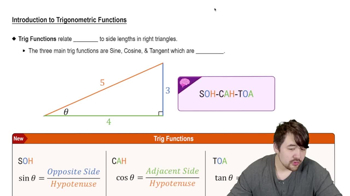
Trigonometric functions, such as sine, cosine, and tangent, relate angles to the ratios of sides in right triangles. In calculus, these functions are important for modeling periodic phenomena and are often differentiated or integrated. Understanding their derivatives, such as the derivative of cos(x) being -sin(x), is crucial for solving problems involving trigonometric expressions.
Video consigliato:
Percorso guidato
6:04
Introduction to Trigonometric Functions
Pratica correlata
Domanda del libro di testo

A capacitor is a device in an electrical circuit that stores charge. In one particular circuit, the charge on the capacitor Q varies in time as shown in the figure. <IMAGE>

b. Is Q′ positive or negative for t≥0?

175
views

Domanda del libro di testo

The energy (in joules) released by an earthquake of magnitude M is given by the equation E = 25,000 ⋅ 101.5M. (This equation can be solved for M to define the magnitude of a given earthquake; it is a refinement of the original Richter scale created by Charles Richter in 1935.)

Compute the energy released by earthquakes of magnitude 1, 2, 3, 4, and 5. Plot the points on a graph and join them with a smooth curve.

482
views
Domanda del libro di testo

Find and simplify the derivative of the following functions.

h(x) = (5x7 + 5x)(6x3 + 3x2 + 3)

315
views
Domanda del libro di testo

Power and energy are often used interchangeably, but they are quite different. Energy is what makes matter move or heat up. It is measured in units of joules or Calories, where 1 Cal=4184 J. One hour of walking consumes roughly 10⁶J, or 240 Cal. On the other hand, power is the rate at which energy is used, which is measured in watts, where 1 W = 1 J/s. Other useful units of power are kilowatts (1 kW=10³ W) and megawatts (1 MW=10⁶ W). If energy is used at a rate of 1 kW for one hour, the total amount of energy used is 1 kilowatt-hour (1 kWh = 3.6×10⁶ J) Suppose the cumulative energy used in a large building over a 24-hr period is given by E(t)=100t + 4t² − (t³ / 9) kWh where t = 0 corresponds to midnight.

The power is the rate of energy consumption; that is, P(t) = E′(t) Find the power over the interval 0 ≤ t ≤ 24.

452
views
Domanda del libro di testo

An object oscillates along a vertical line, and its position in centimeters is given by y(t)=30(sint - 1), where t ≥ 0 is measured in seconds and y is positive in the upward direction.

At what times and positions is the velocity zero?

216
views
Domanda del libro di testo

An object oscillates along a vertical line, and its position in centimeters is given by y(t) = 30(sin t - 1), where t ≥ 0 is measured in seconds and y is positive in the upward direction.

The acceleration of the oscillator is a(t) = v′(t). Find and graph the acceleration function.

220
views