Ch. 3 - Derivatives
Briggs - Calculus: Early Transcendentals 3rd Edition
Briggs3rd EditionCalculus: Early TranscendentalsISBN: 9780136847243Non è quello che usi tu?Cambia libro di testo
Capitolo 3, Problema 56b

Power and energy are often used interchangeably, but they are quite different. Energy is what makes matter move or heat up. It is measured in units of joules or Calories, where 1 Cal=4184 J. One hour of walking consumes roughly 10⁶J, or 240 Cal. On the other hand, power is the rate at which energy is used, which is measured in watts, where 1 W = 1 J/s. Other useful units of power are kilowatts (1 kW=10³ W) and megawatts (1 MW=10⁶ W). If energy is used at a rate of 1 kW for one hour, the total amount of energy used is 1 kilowatt-hour (1 kWh = 3.6×10⁶ J) Suppose the cumulative energy used in a large building over a 24-hr period is given by E(t)=100t + 4t² − (t³ / 9) kWh where t = 0 corresponds to midnight.
The power is the rate of energy consumption; that is, P(t) = E′(t) Find the power over the interval 0 ≤ t ≤ 24.

Guida verificata passo dopo passo
1
Step 1: Understand that power is the derivative of energy with respect to time. Given the energy function E(t) = 100t + 4t^2 - (t^3 / 9), we need to find its derivative to determine the power function P(t).
Step 2: Differentiate the term 100t with respect to t. The derivative of 100t is 100, as the derivative of t with respect to t is 1.
Step 3: Differentiate the term 4t^2 with respect to t. Using the power rule, the derivative of 4t^2 is 8t, since the power rule states that d/dt [t^n] = n*t^(n-1).
Step 4: Differentiate the term -(t^3 / 9) with respect to t. Again using the power rule, the derivative is -(3/9)t^2, which simplifies to -(1/3)t^2.
Step 5: Combine the derivatives from Steps 2, 3, and 4 to form the power function P(t). Therefore, P(t) = 100 + 8t - (1/3)t^2. This function represents the power over the interval 0 ≤ t ≤ 24.

Risposta video verificata per un problema simile:

Questa soluzione video è stata consigliata dai nostri tutor come utile per risolvere questo problema.
Durata del video:
4m

Concetti chiave

Ecco i concetti essenziali che devi comprendere per rispondere correttamente alla domanda.

Energy and Power

Energy is the capacity to do work, measured in joules (J) or calories (Cal), while power is the rate at which energy is consumed or produced, measured in watts (W). Understanding the distinction between these two concepts is crucial, as energy quantifies the total work done, whereas power indicates how quickly that work is performed.
Video consigliato:
04:02
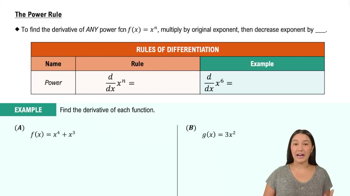
The Power Rule

Derivative in Calculus

The derivative of a function represents the rate of change of that function with respect to its variable. In this context, finding the power as the derivative of the energy function E(t) allows us to determine how energy consumption changes over time, which is essential for analyzing the building's energy usage.
Video consigliato:
Percorso guidato
06:11
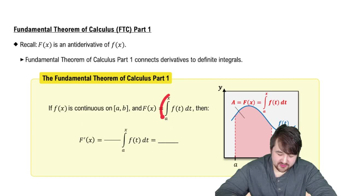
Fundamental Theorem of Calculus Part 1

Units of Measurement

Understanding the units of measurement for energy (joules, kilowatt-hours) and power (watts, kilowatts) is vital for interpreting the results of calculations. Converting between these units, such as knowing that 1 kWh equals 3.6 million joules, helps in accurately assessing energy consumption and power output over specified intervals.
Video consigliato:
5:10
Evaluate Composite Functions - Values on Unit Circle