Ch. 3 - Derivatives
Briggs - Calculus: Early Transcendentals 3rd Edition
Briggs3rd EditionCalculus: Early TranscendentalsISBN: 9780136847243Non è quello che usi tu?Cambia libro di testo
Capitolo 3, Problema 3.6.7

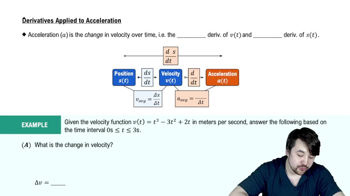
Define the acceleration of an object moving in a straight line.

Guida verificata passo dopo passo
1
Acceleration is defined as the rate of change of velocity of an object with respect to time. It is a vector quantity, meaning it has both magnitude and direction.
To find the acceleration, you need to know the velocity function of the object, which is typically given as v(t), where t represents time.
The acceleration a(t) can be found by taking the derivative of the velocity function v(t) with respect to time t. This is expressed mathematically as: a(t)=dv(t)dt
If the velocity function v(t) is given, apply the rules of differentiation to find the derivative. This involves using techniques such as the power rule, product rule, or chain rule, depending on the form of v(t).
Once you have calculated the derivative, you have the acceleration function a(t), which describes how the velocity of the object changes over time.

Risposta video verificata per un problema simile:

Questa soluzione video è stata consigliata dai nostri tutor come utile per risolvere questo problema.
Durata del video:
2m

Concetti chiave

Ecco i concetti essenziali che devi comprendere per rispondere correttamente alla domanda.

Acceleration

Acceleration is defined as the rate of change of velocity of an object with respect to time. It indicates how quickly an object is speeding up or slowing down. Mathematically, it is expressed as the derivative of velocity with respect to time, and it can be positive (indicating an increase in speed) or negative (indicating a decrease in speed).
Video consigliato:
Percorso guidato
06:15
Derivatives Applied To Acceleration

Velocity

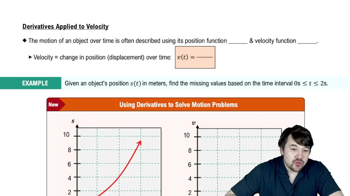
Velocity is a vector quantity that describes the rate at which an object changes its position. It includes both the speed of the object and the direction of its motion. Understanding velocity is crucial for calculating acceleration, as acceleration is derived from changes in velocity over time.
Video consigliato:
Percorso guidato
06:29
Derivatives Applied To Velocity

Kinematics

Kinematics is the branch of mechanics that deals with the motion of objects without considering the forces that cause the motion. It provides the foundational equations and concepts, such as displacement, velocity, and acceleration, which are essential for analyzing the motion of objects in a straight line.