Ch. 3 - Derivatives
Briggs - Calculus: Early Transcendentals 3rd Edition
Briggs3rd EditionCalculus: Early TranscendentalsISBN: 9780136847243Non è quello che usi tu?Cambia libro di testo
Capitolo 3, Problema 3.10.59

Suppose the slope of the curve y=f^−1(x) at (4, 7) is 4/5. Find f′(7).

Guida verificata passo dopo passo
1
Understand that the problem involves the inverse function theorem, which relates the derivatives of a function and its inverse.
Recall the inverse function theorem: If y = f^−1(x) and f is differentiable at y, then the derivative of the inverse function at a point is the reciprocal of the derivative of the original function at the corresponding point. Mathematically, this is expressed as: (d/dx)[f^−1(x)] = 1 / f'(f^−1(x)).
Given that the slope of the curve y = f^−1(x) at (4, 7) is 4/5, this means that (d/dx)[f^−1(x)] at x = 4 is 4/5.
Use the inverse function theorem: 1 / f'(7) = 4/5. This equation relates the derivative of the inverse function to the derivative of the original function.
Solve for f'(7) by taking the reciprocal of 4/5, which will give you the value of f'(7).

Risposta video verificata per un problema simile:

Questa soluzione video è stata consigliata dai nostri tutor come utile per risolvere questo problema.
Durata del video:
4m

Concetti chiave

Ecco i concetti essenziali che devi comprendere per rispondere correttamente alla domanda.

Inverse Function Theorem

The Inverse Function Theorem states that if a function f is continuously differentiable and its derivative f' is non-zero at a point, then its inverse function f^−1 is also differentiable at the corresponding point. The derivative of the inverse function can be calculated using the formula (f^−1)'(y) = 1 / f'(x), where y = f(x). This theorem is crucial for relating the slopes of a function and its inverse.
Video consigliato:
4:49
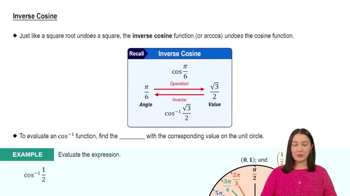
Inverse Cosine

Derivative of a Function

The derivative of a function, denoted f'(x), represents the rate of change of the function's output with respect to its input. It is a fundamental concept in calculus that provides information about the slope of the tangent line to the curve at any given point. Understanding how to compute and interpret derivatives is essential for analyzing the behavior of functions and their inverses.
Video consigliato:
06:30
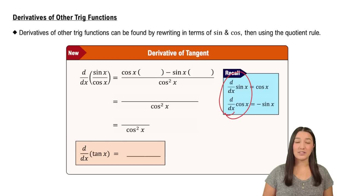
Derivatives of Other Trig Functions

Slope of a Curve

The slope of a curve at a specific point is defined as the value of the derivative at that point. For the curve y = f^−1(x) at the point (4, 7), the slope is given as 4/5. This information is used to find the derivative of the original function f at the corresponding point, which is necessary for solving problems involving inverse functions and their properties.
Video consigliato:
11:41
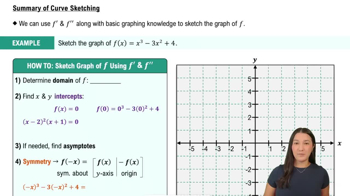
Summary of Curve Sketching