Ch. 3 - Derivatives
Briggs - Calculus: Early Transcendentals 3rd Edition
Briggs3rd EditionCalculus: Early TranscendentalsISBN: 9780136847243Non è quello che usi tu?Cambia libro di testo
Capitolo 3, Problema 90

Derivatives by different methods
a. Calculate d/dx (x²+x)² using the Chain Rule. Simplify your answer.

Guida verificata passo dopo passo
1
Step 1: Identify the outer and inner functions. Here, the outer function is \( u^2 \) and the inner function is \( u = x^2 + x \).
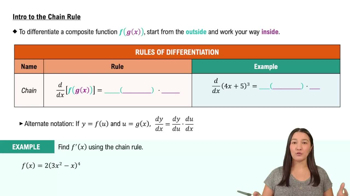
Step 2: Apply the Chain Rule, which states that \( \frac{d}{dx}[f(g(x))] = f'(g(x)) \cdot g'(x) \). In this case, \( f(u) = u^2 \) and \( g(x) = x^2 + x \).
Step 3: Differentiate the outer function \( f(u) = u^2 \) with respect to \( u \), which gives \( f'(u) = 2u \).
Step 4: Differentiate the inner function \( g(x) = x^2 + x \) with respect to \( x \), which gives \( g'(x) = 2x + 1 \).
Step 5: Combine the derivatives using the Chain Rule: \( \frac{d}{dx}[(x^2 + x)^2] = 2(x^2 + x) \cdot (2x + 1) \). Simplify the expression by distributing and combining like terms.

Risposta video verificata per un problema simile:

Questa soluzione video è stata consigliata dai nostri tutor come utile per risolvere questo problema.
Durata del video:
3m

Concetti chiave

Ecco i concetti essenziali che devi comprendere per rispondere correttamente alla domanda.

Chain Rule

The Chain Rule is a fundamental technique in calculus used to differentiate composite functions. It states that if you have a function that is composed of two or more functions, the derivative of the outer function is multiplied by the derivative of the inner function. For example, if y = f(g(x)), then dy/dx = f'(g(x)) * g'(x). This rule is essential for calculating derivatives of functions like (x² + x)².
Video consigliato:
05:02
Intro to the Chain Rule

Power Rule

The Power Rule is a basic differentiation rule that states if f(x) = x^n, where n is a real number, then the derivative f'(x) = n*x^(n-1). This rule simplifies the process of finding derivatives of polynomial functions and is often used in conjunction with the Chain Rule when dealing with powers of functions, such as squaring a binomial.
Video consigliato:
5:50
Power Rules

Simplification of Derivatives

After applying differentiation rules, it is often necessary to simplify the resulting expression to make it more manageable or interpretable. This involves combining like terms, factoring, or reducing fractions. Simplification is crucial for presenting the final answer clearly and can also help in further analysis, such as finding critical points or analyzing the behavior of the function.
Video consigliato: