Ch. 3 - Derivatives
Briggs - Calculus: Early Transcendentals 3rd Edition
Briggs3rd EditionCalculus: Early TranscendentalsISBN: 9780136847243Non è quello che usi tu?Cambia libro di testo
Capitolo 3, Problema 88

Second derivatives Find d²y/dx²for the following functions.
y = √x²+2

Guida verificata passo dopo passo
1
First, identify the function y = √(x² + 2). To find the second derivative, we need to first find the first derivative dy/dx.
Use the chain rule to differentiate y = (x² + 2)^(1/2). The chain rule states that if you have a composite function y = f(g(x)), then dy/dx = f'(g(x)) * g'(x).
Differentiate the outer function f(u) = u^(1/2) with respect to u, which gives f'(u) = (1/2)u^(-1/2). Then, differentiate the inner function g(x) = x² + 2 with respect to x, which gives g'(x) = 2x.
Apply the chain rule: dy/dx = (1/2)(x² + 2)^(-1/2) * 2x. Simplify this expression to find the first derivative.
To find the second derivative d²y/dx², differentiate the first derivative with respect to x. Use the product rule and chain rule as necessary, and simplify the resulting expression.

Risposta video verificata per un problema simile:

Questa soluzione video è stata consigliata dai nostri tutor come utile per risolvere questo problema.
Durata del video:
6m

Concetti chiave

Ecco i concetti essenziali che devi comprendere per rispondere correttamente alla domanda.

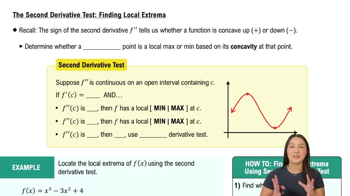
Second Derivative

The second derivative of a function, denoted as d²y/dx², measures the rate of change of the first derivative. It provides information about the concavity of the function and can indicate points of inflection where the function changes from concave up to concave down or vice versa.
Video consigliato:
06:02
The Second Derivative Test: Finding Local Extrema

Chain Rule

The chain rule is a fundamental differentiation technique used when differentiating composite functions. It states that if a function y is composed of another function u, then the derivative of y with respect to x can be found by multiplying the derivative of y with respect to u by the derivative of u with respect to x.
Video consigliato:
05:02
Intro to the Chain Rule

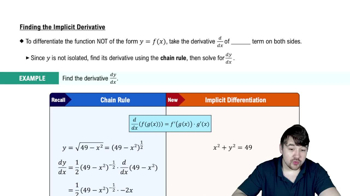
Implicit Differentiation

Implicit differentiation is a method used to differentiate equations where y is not explicitly solved for x. This technique allows us to find derivatives of y with respect to x by treating y as a function of x, even when y is defined implicitly through an equation involving both x and y.
Video consigliato:
Percorso guidato
05:14
Finding The Implicit Derivative