Ch. 3 - Derivatives
Briggs - Calculus: Early Transcendentals 3rd Edition
Briggs3rd EditionCalculus: Early TranscendentalsISBN: 9780136847243Non è quello che usi tu?Cambia libro di testo
Capitolo 3, Problema 59

Determining the unknown constant Let f(x) = {2x² if x≤1 ax-2 if x>1. Determine a value of a (if possible) for which f' is continuous at x=1.

Guida verificata passo dopo passo
1
Step 1: Understand the problem. We need to find a value of 'a' such that the derivative of the piecewise function f(x) is continuous at x=1. The function is defined as f(x) = 2x^2 for x ≤ 1 and f(x) = ax - 2 for x > 1.
Step 2: Ensure f(x) is continuous at x=1. For f(x) to be continuous at x=1, the left-hand limit (as x approaches 1 from the left) must equal the right-hand limit (as x approaches 1 from the right) and also equal f(1). Calculate these limits and set them equal to each other.
Step 3: Differentiate each piece of the function. Find f'(x) for x ≤ 1 and for x > 1. For x ≤ 1, differentiate 2x^2 to get f'(x) = 4x. For x > 1, differentiate ax - 2 to get f'(x) = a.
Step 4: Ensure f'(x) is continuous at x=1. For f'(x) to be continuous at x=1, the left-hand derivative (as x approaches 1 from the left) must equal the right-hand derivative (as x approaches 1 from the right). Set 4(1) equal to a.
Step 5: Solve for 'a'. From the equation 4 = a, determine the value of 'a' that makes f'(x) continuous at x=1.

Risposta video verificata per un problema simile:

Questa soluzione video è stata consigliata dai nostri tutor come utile per risolvere questo problema.
Durata del video:
4m

Concetti chiave

Ecco i concetti essenziali che devi comprendere per rispondere correttamente alla domanda.

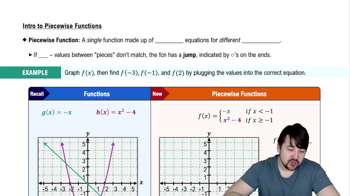
Piecewise Functions

A piecewise function is defined by different expressions based on the input value. In this case, f(x) has two distinct definitions: one for x ≤ 1 and another for x > 1. Understanding how to evaluate and analyze these functions at the boundaries is crucial for determining continuity and differentiability.
Video consigliato:
Percorso guidato
05:36
Piecewise Functions

Continuity of Functions

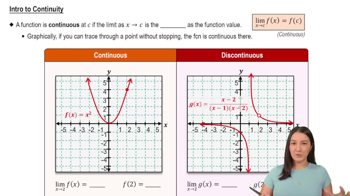
A function is continuous at a point if the limit of the function as it approaches that point equals the function's value at that point. For f(x) to be continuous at x = 1, the left-hand limit (as x approaches 1 from the left) must equal the right-hand limit (as x approaches 1 from the right) and also equal f(1).
Video consigliato:
05:34
Intro to Continuity

Differentiability and Its Relationship to Continuity

A function is differentiable at a point if it has a defined derivative there, which requires the function to be continuous at that point. For f' to be continuous at x = 1, not only must f be continuous at that point, but the derivatives from both sides must also match. This involves calculating f'(x) for both pieces and ensuring they are equal at x = 1.
Video consigliato:
05:34
Intro to Continuity
Pratica correlata
Domanda del libro di testo

Calculate the derivative of the following functions.

y = (1 - e0.05x)-1

351
views

Domanda del libro di testo

Find and simplify the derivative of the following functions.

h(x) = (5x7 + 5x)(6x3 + 3x2 + 3)

315
views
Domanda del libro di testo

Calculate the derivative of the following functions.

y = √x+√x+√x

415
views
Domanda del libro di testo

{Use of Tech} Equations of tangent lines

Find an equation of the line tangent to the given curve at a.

y = −3x2 + 2; a=1

381
views
Domanda del libro di testo

Power and energy are often used interchangeably, but they are quite different. Energy is what makes matter move or heat up. It is measured in units of joules or Calories, where 1 Cal=4184 J. One hour of walking consumes roughly 10⁶J, or 240 Cal. On the other hand, power is the rate at which energy is used, which is measured in watts, where 1 W = 1 J/s. Other useful units of power are kilowatts (1 kW=10³ W) and megawatts (1 MW=10⁶ W). If energy is used at a rate of 1 kW for one hour, the total amount of energy used is 1 kilowatt-hour (1 kWh = 3.6×10⁶ J) Suppose the cumulative energy used in a large building over a 24-hr period is given by E(t)=100t + 4t² − (t³ / 9) kWh where t = 0 corresponds to midnight.

The power is the rate of energy consumption; that is, P(t) = E′(t) Find the power over the interval 0 ≤ t ≤ 24.

452
views
Domanda del libro di testo

{Use of Tech} Equations of tangent lines

b. Use a graphing utility to graph the curve and the tangent line on the same set of axes.

y = −3x²+2; a=1

401
views