
Ch. 3 - Derivatives
Briggs - Calculus: Early Transcendentals 3rd Edition
Briggs3rd EditionCalculus: Early TranscendentalsISBN: 9780136847243Non è quello che usi tu?Cambia libro di testo
Capitolo 3, Problema 3.9.13

Find d/dx (In(xe^x)) without using the Chain Rule and the Product Rule.

Guida verificata passo dopo passo
1
Step 1: Begin by recognizing that the expression inside the logarithm is a product: \(xe^x\). We can use the property of logarithms that \(\ln(a \cdot b) = \ln(a) + \ln(b)\). Apply this property to rewrite the expression as \(\ln(x) + \ln(e^x)\).
Step 2: Simplify \(\ln(e^x)\). Recall that \(\ln(e^x) = x \cdot \ln(e)\), and since \(\ln(e) = 1\), this simplifies to \(x\). Therefore, the expression becomes \(\ln(x) + x\).
Step 3: Differentiate \(\ln(x)\) with respect to \(x\). The derivative of \(\ln(x)\) is \(\frac{1}{x}\).
Step 4: Differentiate \(x\) with respect to \(x\). The derivative of \(x\) is simply \(1\).
Step 5: Combine the derivatives from Step 3 and Step 4. The derivative of \(\ln(x) + x\) is \(\frac{1}{x} + 1\).

Risposta video verificata per un problema simile:

Questa soluzione video è stata consigliata dai nostri tutor come utile per risolvere questo problema.
Durata del video:
4m

Concetti chiave

Ecco i concetti essenziali che devi comprendere per rispondere correttamente alla domanda.

Natural Logarithm Properties

Understanding the properties of natural logarithms is essential for simplifying expressions involving ln. Specifically, the property ln(a*b) = ln(a) + ln(b) allows us to break down the logarithm of a product into a sum, which can simplify differentiation.
Video consigliato:
05:36
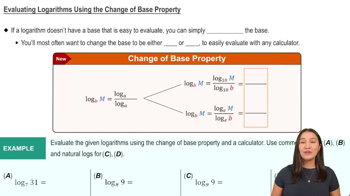
Change of Base Property

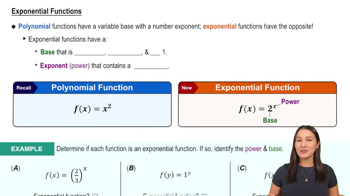
Exponential Functions

Exponential functions, such as e^x, have unique properties that make them easier to differentiate. The derivative of e^x is e^x itself, which simplifies calculations significantly when combined with logarithmic functions.
Video consigliato:
6:13
Exponential Functions

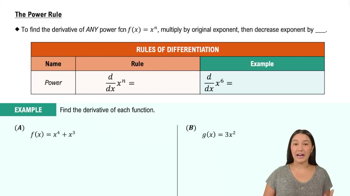
Basic Differentiation Rules

Familiarity with basic differentiation rules, such as the derivative of a constant and the power rule, is crucial. These rules provide the foundation for finding derivatives without relying on more complex techniques like the Chain Rule or Product Rule.
Video consigliato:
04:02
The Power Rule
Pratica correlata
Domanda del libro di testo

Watching an elevator An observer is 20 m above the ground floor of a large hotel atrium looking at a glass-enclosed elevator shaft that is 20 m horizontally from the observer (see figure). The angle of elevation of the elevator is the angle that the observer’s line of sight makes with the horizontal (it may be positive or negative). Assuming the elevator rises at a rate of 5 m/s, what is the rate of change of the angle of elevation when the elevator is 10 m above the ground? When the elevator is 40 m above the ground? <IMAGE>

259
views
Domanda del libro di testo

Find y'' for the following functions.

y = tan x

357
views
Domanda del libro di testo

A line perpendicular to another line or to a tangent line is often called a normal line. Find an equation of the line perpendicular to the line that is tangent to the following curves at the given point P.

y= √x; P(4, 2)

246
views
Domanda del libro di testo

Derivatives Find the derivative of the following functions. See Example 2 of Section 3.2 for the derivative of √x.

f(s) = √s/4

272
views
Domanda del libro di testo

Matching heights A stone is thrown with an initial velocity of 32 ft/s from the edge of a bridge that is 48 ft above the ground. The height of this stone above the ground t seconds after it is thrown is f(t) = −16t²+32t+48 . If a second stone is thrown from the ground, then its height above the ground after t seconds is given by g(t) = −16t²+v0t, where v0 is the initial velocity of the second stone. Determine the value of v0 such that both stones reach the same high point.

290
views
Domanda del libro di testo

Derivatives Find and simplify the derivative of the following functions.

h(w) = w⁵/³ / w⁵/³+1

295
views