
Watching an elevator An observer is 20 m above the ground floor of a large hotel atrium looking at a glass-enclosed elevator shaft that is 20 m horizontally from the observer (see figure). The angle of elevation of the elevator is the angle that the observer’s line of sight makes with the horizontal (it may be positive or negative). Assuming the elevator rises at a rate of 5 m/s, what is the rate of change of the angle of elevation when the elevator is 10 m above the ground? When the elevator is 40 m above the ground? <IMAGE>
Ch. 3 - Derivatives
Briggs3rd EditionCalculus: Early TranscendentalsISBN: 9780136847243Non è quello che usi tu?Cambia libro di testo
Capitolo 3, Problema 3.5.62
Find y'' for the following functions.
y = tan x
Guida verificata passo dopo passo1
Start by identifying the function y = tan(x). To find the second derivative y'', we first need to find the first derivative y'.
Recall the derivative of tan(x) with respect to x is sec^2(x). Therefore, y' = sec^2(x).
Next, we need to find the derivative of y' to obtain y''. This means we need to differentiate sec^2(x) with respect to x.
Use the chain rule to differentiate sec^2(x). Let u = sec(x), then y' = u^2. The derivative of u^2 with respect to x is 2u * du/dx.
Now, find du/dx where u = sec(x). The derivative of sec(x) is sec(x)tan(x). Substitute back to get y'' = 2sec(x) * sec(x)tan(x) = 2sec^3(x)tan(x).

Risposta video verificata per un problema simile:
Questa soluzione video è stata consigliata dai nostri tutor come utile per risolvere questo problema.
Durata del video:
3mConcetti chiave
Ecco i concetti essenziali che devi comprendere per rispondere correttamente alla domanda.
Second Derivative
The second derivative of a function measures the rate of change of the first derivative. It provides information about the concavity of the function and can indicate points of inflection where the function changes from concave up to concave down or vice versa. In this context, finding y'' involves differentiating the function y = tan x twice.
Video consigliato:
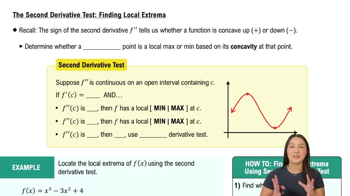
The Second Derivative Test: Finding Local Extrema
Differentiation Rules
Differentiation rules are formulas and techniques used to compute the derivative of functions. Key rules include the power rule, product rule, quotient rule, and chain rule. For the function y = tan x, the derivative can be found using the quotient rule, as tan x can be expressed as sin x / cos x.
Video consigliato:
Percorso guidato
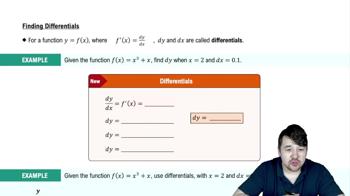
Finding Differentials
Trigonometric Derivatives
Trigonometric derivatives are specific derivatives of trigonometric functions, which have unique rates of change. For example, the derivative of tan x is sec² x. Understanding these derivatives is essential for solving problems involving trigonometric functions, such as finding the second derivative of y = tan x.
Video consigliato:
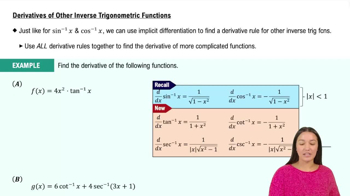
Derivatives of Other Inverse Trigonometric Functions
Pratica correlata
Domanda del libro di testo
259
views
Domanda del libro di testo
Find d/dx (In(xe^x)) without using the Chain Rule and the Product Rule.
386
views
Domanda del libro di testo
A line perpendicular to another line or to a tangent line is often called a normal line. Find an equation of the line perpendicular to the line that is tangent to the following curves at the given point P.
y= √x; P(4, 2)
246
views
Domanda del libro di testo
Derivatives Find the derivative of the following functions. See Example 2 of Section 3.2 for the derivative of √x.
f(s) = √s/4
272
views
Domanda del libro di testo
Derivatives Find and simplify the derivative of the following functions.
h(w) = w⁵/³ / w⁵/³+1
295
views
Domanda del libro di testo
Derivatives of products and quotients Find the derivative of the following functions by first expanding or simplifying the expression. Simplify your answers.
y = 12s³-8s²+12s/4s
267
views
