Ch. 3 - Derivatives
Briggs - Calculus: Early Transcendentals 3rd Edition
Briggs3rd EditionCalculus: Early TranscendentalsISBN: 9780136847243Non è quello che usi tu?Cambia libro di testo
Capitolo 3, Problema 3.3.70

Find f′(x), f′′(x), and f′′′(x) for the following functions.
f(x) = 3x2 + 5ex

Guida verificata passo dopo passo
1
Start by identifying the function f(x) = 3x^2 + 5e^x. We need to find the first, second, and third derivatives of this function.
To find the first derivative f′(x), apply the power rule to the term 3x^2 and the derivative of e^x to the term 5e^x. The power rule states that the derivative of x^n is n*x^(n-1).
For the term 3x^2, using the power rule, the derivative is 2*3*x^(2-1) = 6x. For the term 5e^x, the derivative of e^x is e^x, so the derivative is 5e^x.
Combine the derivatives from the previous step to get f′(x) = 6x + 5e^x.
To find the second derivative f′′(x), differentiate f′(x) = 6x + 5e^x again. Apply the power rule to 6x and the derivative of e^x to 5e^x. Then, differentiate once more to find the third derivative f′′′(x).

Risposta video verificata per un problema simile:

Questa soluzione video è stata consigliata dai nostri tutor come utile per risolvere questo problema.
Durata del video:
5m

Concetti chiave

Ecco i concetti essenziali che devi comprendere per rispondere correttamente alla domanda.

Differentiation

Differentiation is the process of finding the derivative of a function, which represents the rate of change of the function with respect to its variable. It involves applying rules such as the power rule, product rule, and chain rule to compute the first derivative, denoted as f′(x). Understanding differentiation is essential for analyzing the behavior of functions, including their slopes and rates of change.
Video consigliato:
Percorso guidato
05:53
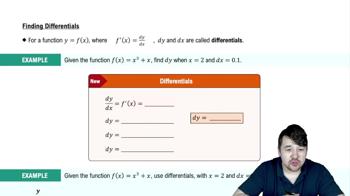
Finding Differentials

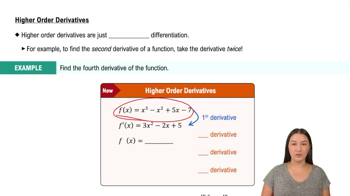
Higher-Order Derivatives

Higher-order derivatives are derivatives of derivatives. The second derivative, f′′(x), provides information about the concavity of the function, while the third derivative, f′′′(x), can indicate the rate of change of the concavity. These derivatives are crucial for understanding the function's behavior beyond just its slope, including identifying points of inflection and acceleration.
Video consigliato:
02:42
Higher Order Derivatives

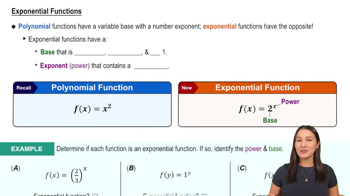
Exponential Functions

Exponential functions, such as e^x, are functions where a constant base is raised to a variable exponent. They have unique properties, including that their derivative is equal to the function itself, which simplifies differentiation. Recognizing how to differentiate exponential functions is vital when working with mixed functions, as seen in the given function f(x) = 3x² + 5e^x.
Video consigliato:
6:13
Exponential Functions