Ch. 3 - Derivatives
Briggs - Calculus: Early Transcendentals 3rd Edition
Briggs3rd EditionCalculus: Early TranscendentalsISBN: 9780136847243Non è quello che usi tu?Cambia libro di testo
Capitolo 3, Problema 3.5.59

Find y'' for the following functions.
y = ex sin x

Guida verificata passo dopo passo
1
First, identify the function y = e^x * sin(x). This is a product of two functions, so we will use the product rule for differentiation.
Apply the product rule: If y = u * v, then y' = u' * v + u * v'. Here, let u = e^x and v = sin(x).
Differentiate u = e^x to get u' = e^x. Differentiate v = sin(x) to get v' = cos(x).
Substitute these derivatives into the product rule formula: y' = e^x * sin(x) + e^x * cos(x).
Differentiate y' again to find y''. Use the product rule on each term separately: For the first term, differentiate e^x * sin(x) again, and for the second term, differentiate e^x * cos(x). Combine these results to find y''.

Risposta video verificata per un problema simile:

Questa soluzione video è stata consigliata dai nostri tutor come utile per risolvere questo problema.
Durata del video:
5m

Concetti chiave

Ecco i concetti essenziali che devi comprendere per rispondere correttamente alla domanda.

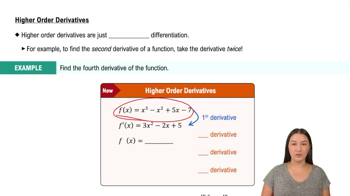
Higher-Order Derivatives

Higher-order derivatives refer to the derivatives of a function beyond the first derivative. The second derivative, denoted as y'', measures the rate of change of the first derivative, providing insights into the function's concavity and acceleration. Understanding how to compute higher-order derivatives is essential for analyzing the behavior of functions in calculus.
Video consigliato:
02:42
Higher Order Derivatives

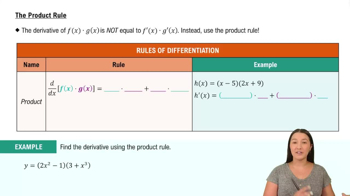
Product Rule

The product rule is a fundamental differentiation technique used when finding the derivative of the product of two functions. It states that if u(x) and v(x) are functions, then the derivative of their product is given by u'v + uv'. This rule is particularly important when differentiating functions like y = e^x sin x, which is a product of two distinct functions.
Video consigliato:
05:18
The Product Rule

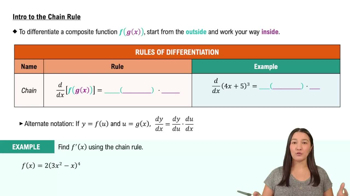
Chain Rule

The chain rule is a method for differentiating composite functions. It states that if a function y is composed of another function u, then the derivative of y with respect to x is the derivative of y with respect to u multiplied by the derivative of u with respect to x. This rule is crucial when dealing with functions that involve exponentials and trigonometric functions, as seen in y = e^x sin x.
Video consigliato:
05:02
Intro to the Chain Rule