Ch. 3 - Derivatives
Briggs - Calculus: Early Transcendentals 3rd Edition
Briggs3rd EditionCalculus: Early TranscendentalsISBN: 9780136847243Non è quello che usi tu?Cambia libro di testo
Capitolo 3, Problema 3a

If two opposite sides of a rectangle increase in length, how must the other two opposite sides change if the area of the rectangle is to remain constant?

Guida verificata passo dopo passo
1
Start by recalling the formula for the area of a rectangle, which is given by \( A = l \times w \), where \( l \) is the length and \( w \) is the width.
Since the area \( A \) is to remain constant, we can express this as \( l_1 \times w_1 = l_2 \times w_2 \), where \( l_1 \) and \( w_1 \) are the original dimensions, and \( l_2 \) and \( w_2 \) are the new dimensions.
If two opposite sides (say the lengths) increase, then \( l_2 > l_1 \). To keep the area constant, the product \( l_2 \times w_2 \) must equal \( l_1 \times w_1 \).
To maintain the equality, the width \( w_2 \) must decrease such that \( w_2 = \frac{l_1 \times w_1}{l_2} \). This ensures that the product of the new dimensions equals the original area.
Thus, as the length increases, the width must decrease proportionally to maintain the constant area of the rectangle.

Risposta video verificata per un problema simile:

Questa soluzione video è stata consigliata dai nostri tutor come utile per risolvere questo problema.
Durata del video:
3m

Concetti chiave

Ecco i concetti essenziali che devi comprendere per rispondere correttamente alla domanda.

Area of a Rectangle

The area of a rectangle is calculated by multiplying its length by its width (A = l × w). This fundamental formula is crucial for understanding how changes in the dimensions of the rectangle affect its overall area. If one dimension increases, the other must adjust to maintain a constant area.
Video consigliato:
Percorso guidato
07:59
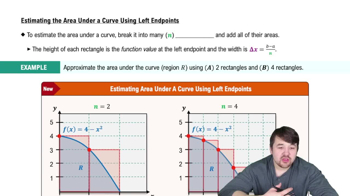
Estimating the Area Under a Curve Using Left Endpoints

Inverse Relationship

An inverse relationship occurs when one quantity increases while another decreases, such that their product remains constant. In the context of the rectangle, if the lengths of two opposite sides increase, the lengths of the other two sides must decrease proportionally to keep the area unchanged.
Video consigliato:
4:49
Inverse Cosine

Proportionality

Proportionality refers to the relationship between two quantities where a change in one quantity results in a corresponding change in another. In this scenario, the lengths of the opposite sides of the rectangle are proportional to each other, meaning that if one pair of sides increases, the other pair must decrease in a specific ratio to maintain the constant area.